
Narrative of Absence Beyond the Marble Column
Article, archeaopoetic | hamza alfallah
In Jacques Derrida’s philosophy of the trace, the concepts of presence and absence intertwine. This intertwining stands against the illusion of Western philosophy of presence as the complete and final origin of things. In 2023, it happened that I was working in the city of Shahat for two consecutive months. This work provided me with the opportunity to frequently visit the archaeological site of the ancient city of Cyrene, particularly the Temple of Zeus — the largest Greek temple in North Africa and the second largest dedicated to Zeus. This period preceded my visits to the rock art sites in eastern Libya and our discoveries in the Black Mountains. Yet, it was not devoid of a certain dimness in my view of classical Greek antiquities, due to that excess of clarity that robbed them of interpretive mystery. There was no void, no significant space for absence or possibility capable of creating wonder and tension when standing before this type of archaeological site. This impression perhaps left me with a lingering question about presence that could be considered a trace carrying a deferred and semantically tense dimension within its absence.
In 2025, the visit was repeated, but this time headed directly to the rock art sites in eastern Libya, accompanied by the writer Mohamed Abdullah Altrhouni, after staying in the city of Shahat. There, this question found a much clearer answer than before, while studying the murals in caves within the context of the natural landscape. Rock art, as an absence, drove us to pursue it night and day from one valley to another. But what kind of absence? It was an absence that granted narrative space for thought before its writing. When we stood before a mural, we stood directly facing an epistemological anxiety carried by these symbolic representations and signs of something present that could no longer be fully recovered. This feeling is precisely what gives these remains and engravings a meaning that imposes the permanence of its own production. I remember well that upon returning from that field experience—so different from my work in Shahat—I carried in my memory two images of the trace, not one: the image of the Temple of Zeus — that monologic, academic, archive-bound narrative — in contrast to an original, unenclosed discourse open to interpretation.

[Image 1: Haua Fteah Cave site]
Rock art is a trace of pursuit that cannot, under any circumstances, be understood in isolation from the natural landscapes that simultaneously produce and reproduce it. Walking through valleys, climbing mountains, and penetrating isolated caves—whose nests trembled upon entry and remained silent—form an essential part of this trace’s semantic structure. For they do not present the researcher with ready-made, short-sighted data, but rather with a continuous delay, sensually connected each time we approach deciphering their mystery. This stands in contrast to the marble statue, which can be isolated, transported, and contained within a museum space, reproduced within an interpretive context not devoid of colonial narrative mechanisms that rearrange the trace according to an external epistemic center. Within this context, the Greek or Roman trace is reproduced as something complete, classifiable, and possessable—which does not align with Derrida’s deconstruction of the meaning of presence and absence. This deconstruction directs me instead to look at rock art engravings—those unarchived narratives of murals that cannot be isolated from their original spatial context. For they are only containable through it, and by virtue of their absence within the natural depth of caves—which does not indicate weakness of presence, but rather a form of interpretive protection that hinders the possibility of subjecting them to a ready-made or centralized narrative.

[Image 2: Shi’b al-Qulta site]
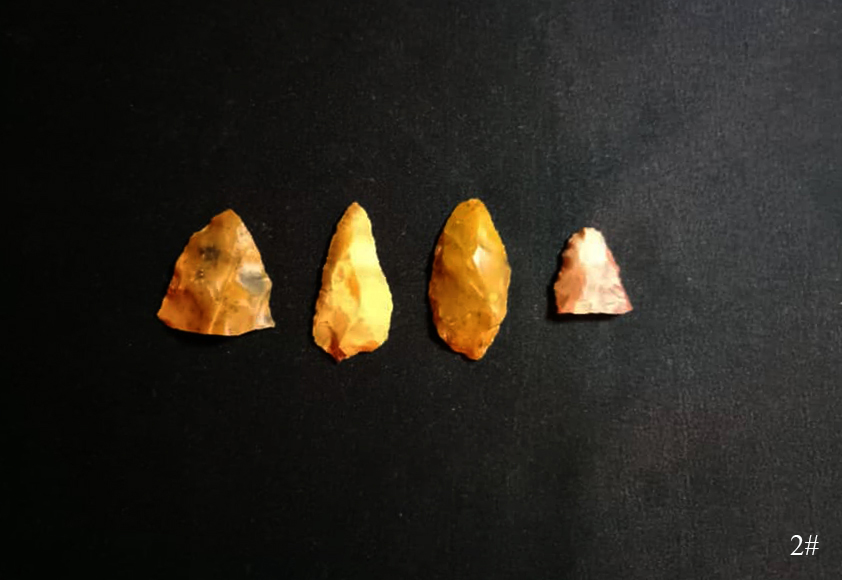
On our recent journey to the Black Mountains, we lived in a constant feeling of falling into a temporal gap, bearing the character of passion for the unknown, as if we were chasing a perpetually shifting nostalgia. This state necessarily pushed us away from everything associated with classical Roman antiquities in the Jufra region. On a visit to Wadi Nina, I remember we stood before a Roman cistern for collecting rainwater and the remains of a collapsed stone building. Because we were hearing the whisper of the “drawings/engravings” we were on our way to with Abdul Latif, the broken stone column seemed to us a trace without a trace. Altrhouni looked at the remains of the column with visible laziness and apathy, without feeling any sorrow for it—unlike the anger I observed in him when he exploded in fury over the increasing encroachments on the engravings in Wadi Tajinat. Recalling this specific moment of our journey passing by the Roman trace is to shift the trace to another level of absence, far from the space of rock art and the natural landscape, through small archaeological finds. Despite their intense material presence in the palm of the hand, they carry, regardless of their small size, a double meaning due to their absence—more complex than the cylindrical column we left behind at the northern end of the Wadi Nina agricultural project. But how can we view these archaeological finds and their culture through this level of absence despite their materiality? The aesthetics of these finds, which we encountered at every site in the Black Mountains—despite their complete loss of original context and being treated archaeologically as finds subject to study, examination, and classification—lie not in their material presence but in the authenticity of their existence. As traces that lost their initial conditions of appearance yet continued to endure. From the Lower Paleolithic to the Middle Paleolithic to the Late Saharan Neolithic, we observed this silent absence without complete significations. In every hand axe, every rough side scraper whose age can be estimated at over 150,000 years ago, there the ancient Libyan was resisting extinction by leaving messages in the form of finds that sought to comfort this nostalgia within us—like a hand patting our shoulders and telling us: had it not been for these primitive tools made for digging the earth, shattering the bones of large animals, or scraping thick hides, you would not have been able to connect with us. At the level of Jacques Derrida’s concept of the trace, in the field of rock art and prehistoric archaeology, we move spiritually and connect emotionally with the highest degree of deficiency—which grants us the possibility of producing narratives not besieged by fragile presence, through an interdisciplinary text on a never-ending journey across all sites, from a path deep within a shelter or cave to a small find of pure quartz gleaming under the sun’s rays.

[Image 3: Wadi al-Sarrat site]
Appendix: Approximate Catalogue of Selected Archaeological Finds from the Black Mountains:

Table 1: Chronological Record and Technical Classification of Lithic and Environmental Finds in the Black Mountains Region.




Hamza alfallah
writer and researcher
Share now: