Threads of Light
Article: Shamanism, Mohammed Abdallah altrhuni
From some perspectives, the emergence of Pleistocene art and the creation of rock art were linked to global changes, such as subsistence strategies, migration, and social organization. From our perspective, however, the cause is linked to climate and climatic changes that transformed into a nightmare requiring supernatural power to control. If we speak of the Pleistocene in its broad sense, it extends from 1.75 million years ago to 10,000 BC. The truth is that symbolic behavior only appeared around 100,000 years ago. In an article by François Gasse titled *“Climatic and Hydrological Changes in Tropical Africa Over the Past Million Years,” * he states: “Africa has experienced climatic changes and a gradual increase in aridity over the past 3,000,000 years, primarily due to orbital cycles coupled with the onset and intensification of glacial cycles at high latitudes.”
These changes are ultimately linked to the emergence of shamanism and the rain religion throughout Africa. Shamanism, in its essence, deals with problems that have no known boundaries—problems requiring conscious interaction with a supernatural power to gain control over them and find solutions. The shaman emerged as a person with special abilities to deal with these problems by entering a trance state enabling communication with supernatural beings. The greatest of these problems was drought and the absence of rain, without which the continuation of life could not be guaranteed. The prehistoric shaman was a person capable of influencing climatic changes, not merely predicting them. Libya is part of Africa, and the climatic changes there contributed to the emergence of shamanism. At the same time, shamanism, within specific climatic contexts, contributes to our understanding of climatic and environmental changes in the region.
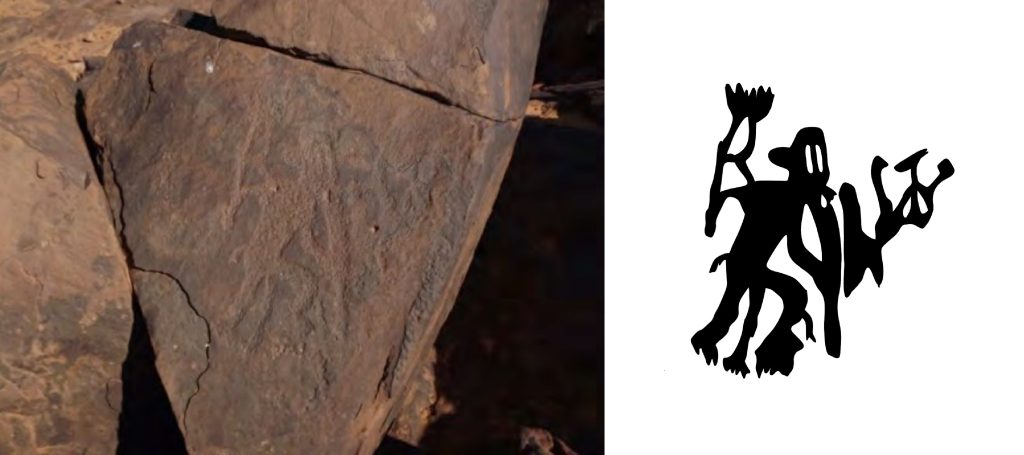
Wadi al-Baqar (Valley of the Cow) is located in the Fezzan Basin in southern Libya, at the intersection of longitude 12.848928°E and latitude 27.597147°N. In this valley, there are unique shamanic engravings on open-air rocks. The shamanic perspective and the theme of rain-making dominate the murals of this valley. In (Figure 1), we see a figure wearing an elephant mask in the context of performing shamanic trance rituals[^1].
1- Photo Louai A. Abdulhamid / Copy Shefa salem
Behind this figure’s back, there is a plant resembling flowers, raised upwards. This plant is called “butcho” ; it appears in rain-making rituals and the extraction of the rain animal from the water hole, and is traditionally used as a tranquilizer during trance rituals. In (Figure 2), we see the same plant on the arms of the man attempting to calm the rain animal. In (Figure 3), we find a figure extending their hand with the buchu plant to calm the rain bull while it is being pulled from the water hole. To the left of the image, there is another figure wearing a mask, but it is incomplete due to poor definition. This indicates that this figure was dancing during the performance of trance rituals, and that they are about to bring the rain animal, which in truth represents the water within the water hole. Rain rituals cover most rock art sites in Libya, but these rituals, in the absence of the shamanic perspective, have been neglected due to the complexity of their interpretation. Contributing to this neglect was the failure to use ethnography as a tool for interpretation; the focus was often on formal structure, neglecting the identity of the mural itself and the context in which it could be discussed. Wadi al-Baqar has been completely neglected, only coming to light through the photographs of Loai Abdulhamid, a PhD candidate in philosophy.
2 Article Ed. Shirley-Ann Pager.
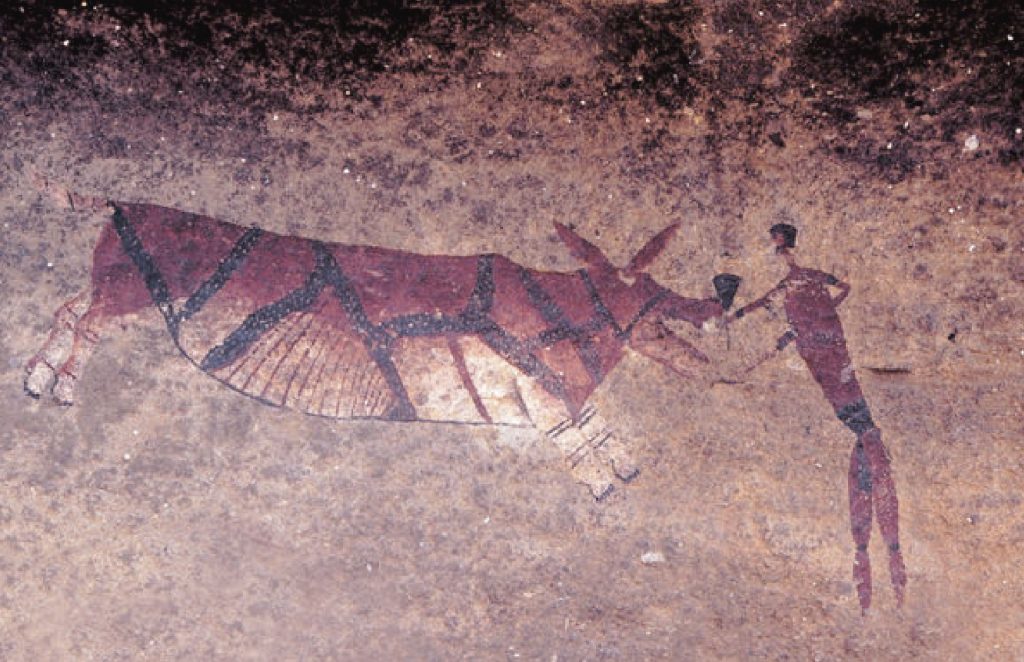
3 photo by Neil Lee, RARI archive
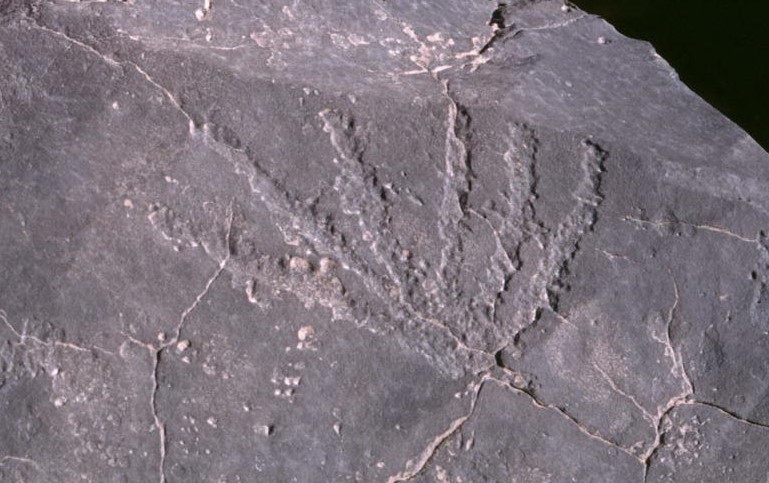
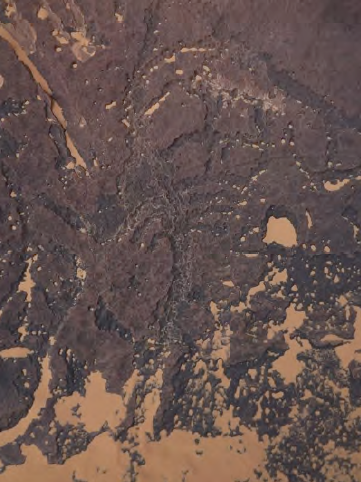
In another mural (Figure 4) from Wadi al-Baqar, Loai Abdulhamid describes it as “scenes of birds, flowers, and palm trees.” However, what is seen ascending to the sky are none other than the threads of light depicted in rock art in this manner, as in (Figure 5).
4-Photo Louai A. Abdulhamid
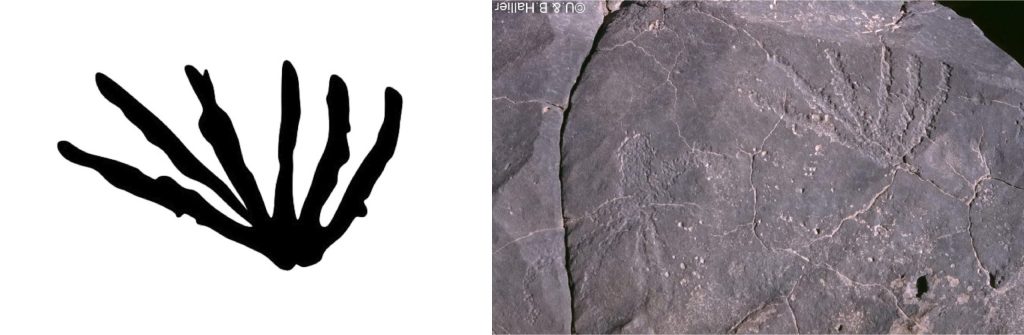
5- photo by U & B Hallier ,Djado / Copy Shefa salem
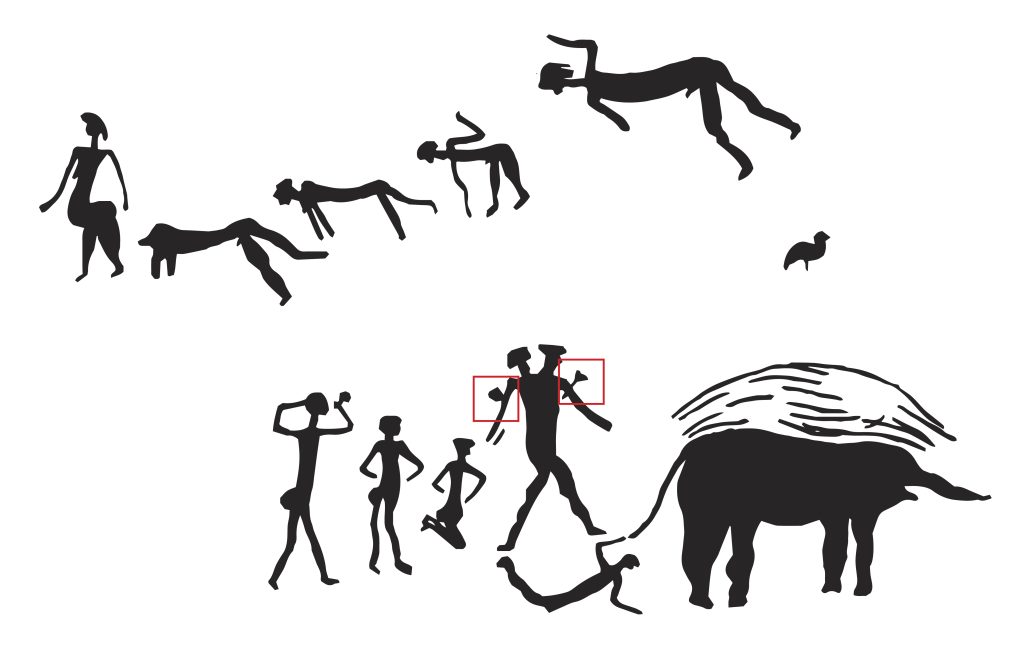
In the book “The Archaeology of Shamanism” edited by Neil S. Price, Lewis-Williams discusses the painting (Figure 6) in an article titled “Shamanism in Southern Africa: The Rock Art Engravings in their Social and Cognitive Contexts,” stating:
“A rock painting of a shamanic dance. In the center, two or more figures are dancing, holding what appears to be a rope studded with white dots. To the right, another figure holds the rope above their head. This rope represents the spiritual threads of light that the shaman climbs while ascending to the sky to bring rain.”
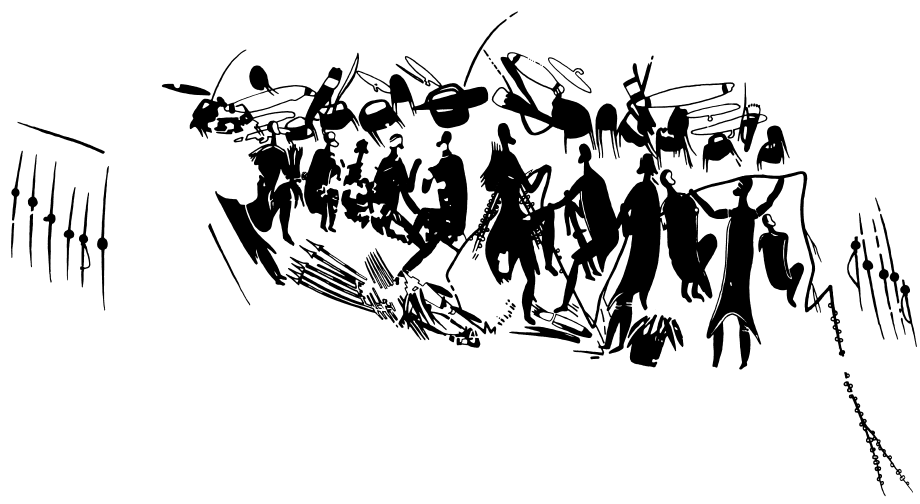
6- copy by Harald Pager.
These threads lead to the spirit world and are visible only to the shaman possessing supernatural power. During the dance, at its climax, the shaman ascends spiritually to the house of water. During their ascent, the women strike the ground with round stones to communicate with the spirit world. These threads, as in (Figure 7), represent, in Lewis-Williams’s words, the shaman’s path during the out-of-body journey. This account is supported by statements from informants /Xashao D!xao and /Xashao /’o, who said the thread is the supernatural power known as n/om, as well as by Uma D!xo, who described it as something from n!om. On this journey, the shaman passes through the water hole, depicted as a qalta on the ground or on the standing wall within the shelter.
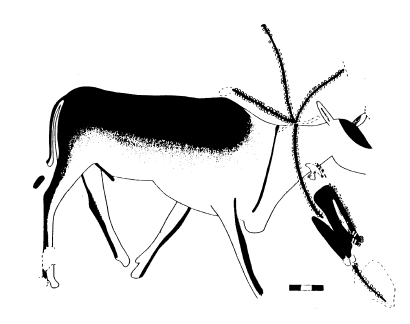
7- recorded by J. D. Lewis-Williams
These threads appear in Wadi al-Baqar (Figure 8), depicting the shaman’s journey to the spirit world. In the center, the shaman is at the beginning of the journey, with threads of light above their head. The posture of the shaman’s body gives the impression of ascending upwards and the start of the journey. On the right, we find the shaman who has left their body, transformed into a spirit ascending upwards. In this part of the journey, there is no clear body, but rather something resembling a transparent fluid symbolizing the shaman’s spirit. Also in this part, the spirit is completely connected to the threads of light, in the midst of ascending to the spirit world where the house of water lies. The section on the left represents the network of difficulties the shaman encounters and the struggles they undergo to reach the house of water.
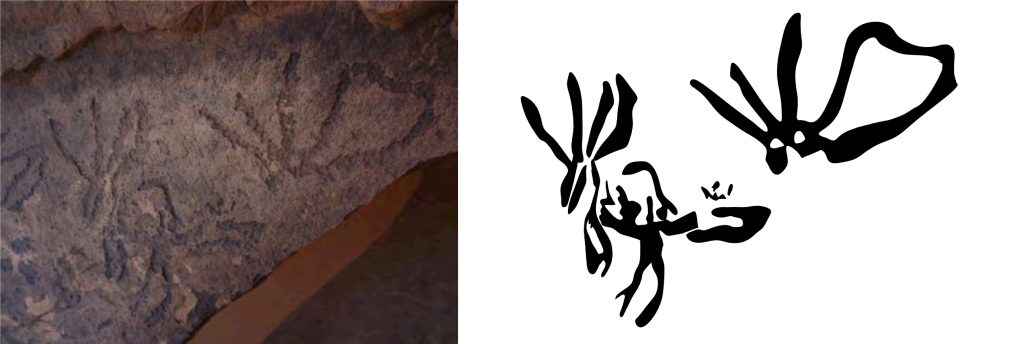
8- Photo Louai A. Abdulhamid / Copy Shefa salem
Returning to the mural (Figure 4), which Loai Abdulhamid described as containing palms, flowers, and birds, we believe it is an incomplete mural due to the photography focusing only on the center of the composition. Whatever the case, such murals, often described as abstract and incomprehensible, are, in fact, from an ethnographic and shamanic perspective, open to interpretation and understanding. Climbing the threads of light is a metaphor for reaching the place of rain that has ceased to fall. Climatic changes compelled the shaman to invent this journey and reach the place of rain, negotiating with the spirits and struggling with them if necessary to release their grip on the rain. During the trance dance, the shaman sees these threads and, in the altered state of consciousness, climbs them to reach the house of water. If they fail to climb and fall (i.e., exit the altered state of consciousness before arrival), they remain away from people, returning only at night to try again on another day when luck might be on their side and rain will fall.
[^1]: *For more on the elephant and its relationship with rain, refer to the article “The Elephant, the Rainmaker” on the Chuwint website.*

Mohammed Abdallah AlThrhuni
writer and researcher
Share now: