
The Man of Water
Article: Shamanism, Mohammed Abdallah altrhuni
In an article titled “Mankhwala, The Rainmaker”, the author, Paul J. Bann, states:
“Mankhwala, whose name literally means ‘Mother of Children’ and, in essence, ‘Mother of All People’, was one of the most powerful rainmakers in Central Africa. Mankhwala presided over a rain shrine with influence extending over most of central Malawi. She was viewed as connected to the sky, and without her, people believed rain would not fall and women might become barren. It is said she could never cut her hair, as doing so was akin to cutting the rain. Her powers were so highly esteemed that in the early 19th century, she received tribute from areas as distant as present-day Zimbabwe. The tribute consisted of valuable items like ivory, and it is said Mankhwala slept on a bed made of elephant ivory covered with black cloth to hide its whiteness. Nothing white was allowed near Mankhwala because it was believed to affect rainfall.
Mankhwala was a spiritual medium, the guardian of the rain shrine in Msinga, and the messenger of rain. When a Mankhwala died, people would wait, sometimes for many years, until another Mankhwala clearly possessed would appear, uttering prophecies and answering a set of secret questions. The rain-invoking ritual was known as ‘Mkhwiza’. In these rituals, Mankhwala would go to a nearby pool called ‘Malawi Pool’ and immerse herself in it for three days. The area around the pool was sacred; no one was allowed to enter except Mankhwala. Also, no trees around the pool could be cut, and no one was allowed to hunt in it, drink from it, or bathe in it. All animals and birds around the pool were considered sacred and protected. This pool was sometimes called ‘The Pool of the Ancestors’ and was believed to be one of the places where a ‘thonga’ might appear. In the public part of the ‘Mkhwiza’ ritual, Mankhwala and the ‘matsano’ (the drummer) would dance and sprinkle water into the air. Offerings, such as black animals, were made at the shrine, and it is said heavy rain would fall even before the rituals were complete. If rain did not fall, the ‘tsang’oma’ would be blamed and killed.”1
Mankhwala is not a shaman; she is a possessed person, meaning she is a spiritual medium. Mircea Eliade distinguishes between the journey of the soul and spiritual possession. As for Loïc Le Quellec, he states that “shamanism and spirit possession are polar opposites,” adding: “The shaman is not an instrument of the spirits but their master… he is the captor, not the captive; the tamer of spirits, not their mount.”2
The shaman is linked to a journey when drought and its regime prevail. When the vast space unfolds before him and he hears the din of the sun, he must undertake his journey to bring rain. “Our mothers used to say: when a star falls from the sky, it enters a water hole (al-qalta), and when it enters, it makes a sound like a shiver. We hear it as the sound of pouring rain, and when it reaches the water hole, it gathers there.”3 The star cools after its fall, and the place where it fell becomes the water hole into which the shaman enters and launches his journey to the house of water. The Bushmen’s explanation for the falling star is that a shaman died during trance and took his power to the water hole. “When he dies, his heart falls like rain. It seems like rain because it is the sound of a shaman’s heart entering the water hole, and because it is inside the water hole, it is alive. And this water is the same from which the rain bulls are drawn.”4
For the Bushmen, rain is a man. “The pillars of the rain are his legs, and his breath is the mist. The ribs of the rain are the dark, dense clouds.”5 In the book “Specimens of Bushman Folklore”, the authors W.H.I. Bleek and L.C. Lloyd recount in the tales a Bushman saying: “A man he is, rain he is. I suppose he was a water sorcerer.”6 And in a tale titled “A Woman of the Early Race and the Rain Bull”, the story says:
“The rain was wooing a young girl. While the girl was in her hut, because she felt ill, the rain smelled her scent (meaning the scent of her menstrual blood) and came out for her while the place was misty.” The girl asks herself: “Who is this man who comes to me?” In another passage, it says: “Because the rain wanted me to go to the water hole, the water hole from which he emerged while courting her.”7
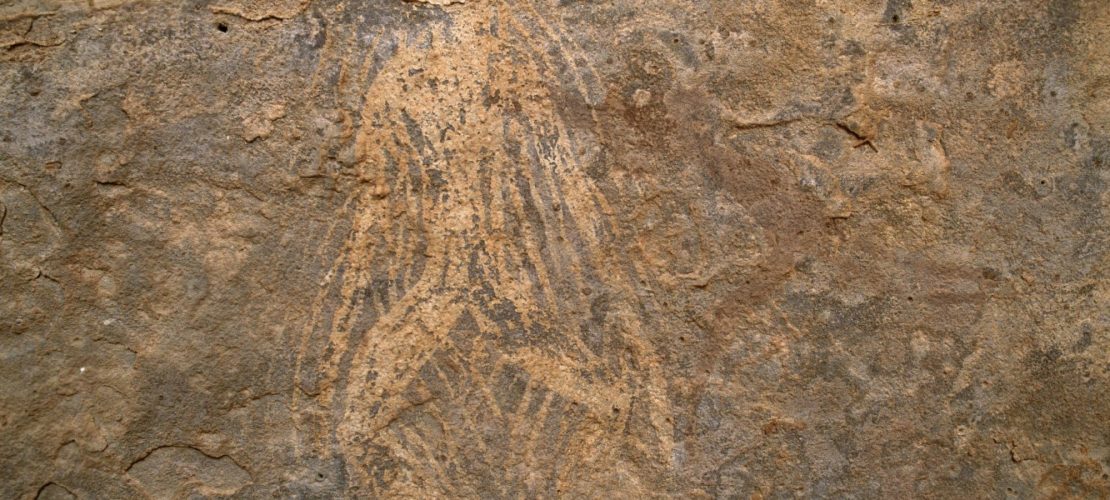
I have never seen any mural that depicts rain as a man except in Wadi Intaharin in the Acacus. In (Figure 1), rain is embodied as a man, confirming the Bushmen’s words that rain has legs which are the feet of the rain, and ribs which are the dense, dark clouds. The man’s head is open, with raindrops and streams falling from it. His hands reach the ground vertically and densely, and his feet are open on the ground for the water to reach them. At the same time, his head is the water hole that the shaman directly behind him wants to reach. The shaman’s movement indicates he is on his journey to the house of water and that he emerged from the hole symbolized by his open foot in the center, forming the water hole.
Perhaps there is no mural that embodies this Bushman concept as clearly, but here in the Acacus, the concept is embodied brilliantly. In the rock art literature written by scientists who reached Libya, the water hole is nothing but a grinding vessel, as in (Figure 2) from Wadi Imha, whereas it was fundamental in the beliefs and rituals of Libya’s inhabitants at that time.
Here, we must cite Laurence Blondel’s statement:
“The precise meaning of meanings lies outside the scope of prehistoric archaeology, which must content itself humbly with understanding structures rather than the meaning of the forms it studies, in the strict sense of the word.”8
The water hole or al-qalta is the beginning of a journey to a multi-layered world undertaken by the shaman to reach the house of water and bring rain. The shaman travels with his helping animal on a journey through a network of ordeals, at the end of which the shaman succeeds in controlling the spirits and causing rainfall. Without an archaeo-poetic interpretation, the mural of Wadi Ain Tahrin would have no meaning. And without using ethnography as a tool for understanding, we would be left with a pale description bearing no relation to the mural.
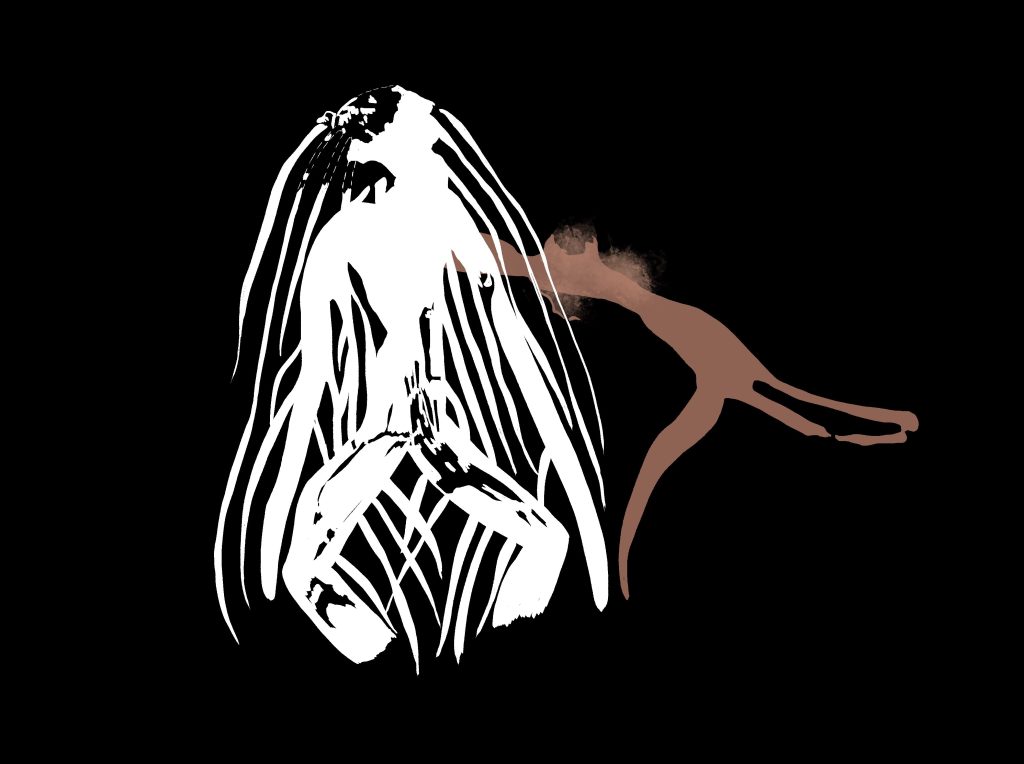
1- Copy by shefa salem ©Teshuinat
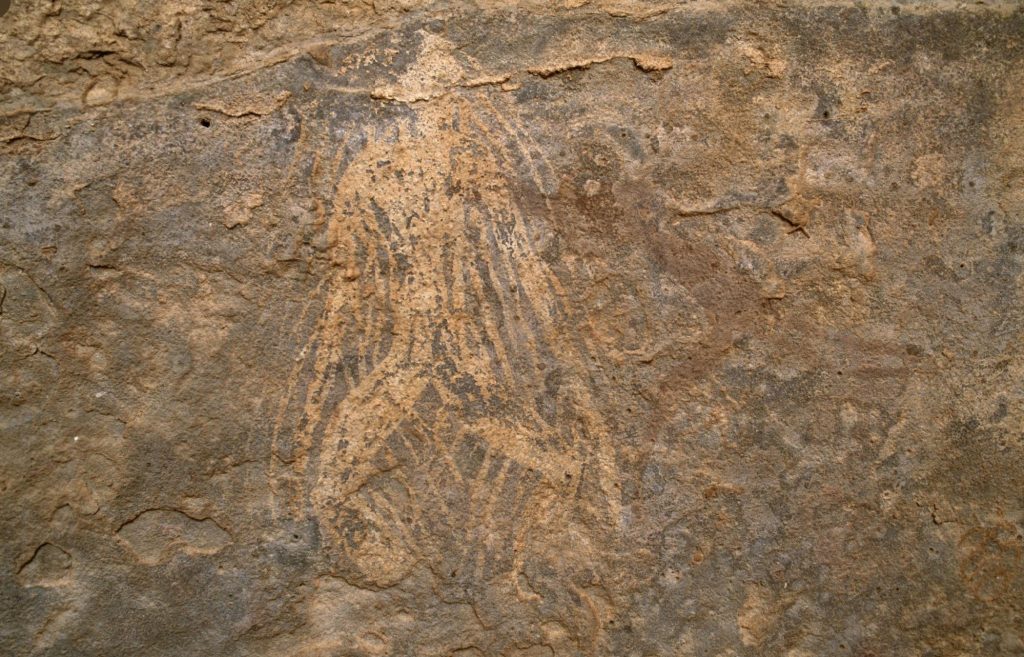
1- ©David Coulson MBE, Trust for African Rock Art
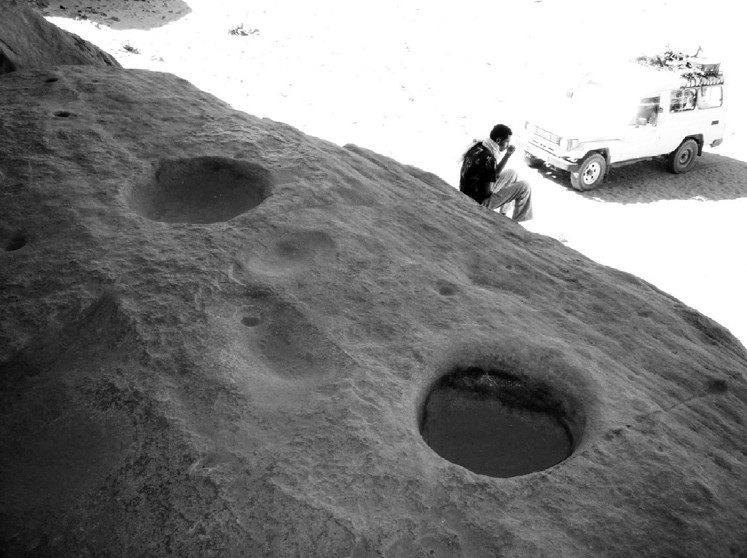
2- Wadi Imha ©Jitka Soukopova
[1] The Encyclopedia of Religion and Nature-Edited by: Bron Taylor-Published online:2010- p 1028-1030.
[2] Ethnographic Perspectives on Differentiating Shamans from other Ritual Intercessors- H. Sidky-Asian Ethnology Volume 69, Number 2 • 2010, 213–240.
[3] BELIEFS AND CUSTOMS OF THE |XAM BUSHMEN- D. F. BLEEK -Routledge- Published online: 31 Mar 2011- p 27.
[4] ibid. 32
[5] BELIEVING AND SEEING-meanings in southern San rock paintings-James David Lewis-Williams-University of Natal, Durban-1979- p 256.
[6] Specimens of Bushman Folklore -W.H.I. Bleek and L.C. Lloyd-Global Grey- 2018- p 87
[7] ibid.n.p
[8] The Shamans of prehistory : trance and magic in the painted caves-Jean Clottes and David Lewis-Williams- Seuil-1996- p 79.

Mohammed Abdallah AlThrhuni
writer and researcher
Share now: