The land of Garamantes
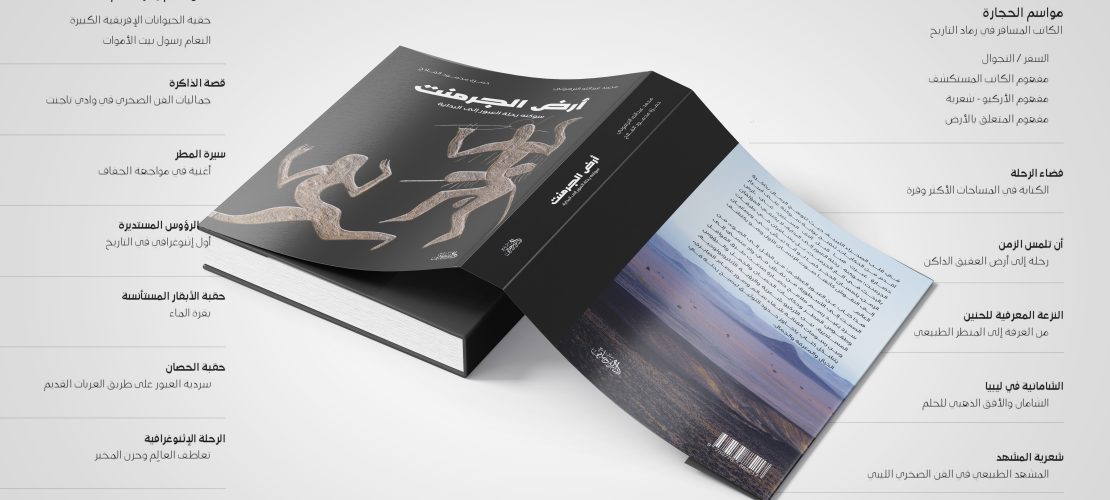
This project, published in 2026, comes as the first Libyan book presented with a Libyan vision in the field of rock art, and deals, through fourteen chapters, with an exploratory journey deep into the valleys of the city of Sukna.
The historical and intellectual richness provided to us by Libyan rock art does not stop at the boundaries of rock representations and engravings alone. Rather, it extends to place it at the forefront of global rock arts, due to several factors, most notably the diversity of its sites and subjects, in addition to its aesthetics and symbolic significations. Our vision for Libyan rock art stems from transcending symbol to meaning, and our project in this context falls within the framework of promoting Libya’s diverse history. It relies on a specific approach that undertakes the responsibility of a meditative and analytical re-reading of the murals across various Libyan sites, organizing them within a clear cognitive system for the audience by presenting them through the shamanic perspective.
In the book The Land of the Garamantes, the journey to the valleys surrounding the Libyan city of Sokna formed the starting point for this collaborative work. The book is authored by the critic and writer Mohammed Abdullah Al-Tarhuni and the poet and writer Hamza Al-Fallāh, with artistic reproduction, rendering, and illustration of the murals by the artist Shifa Salem. In this book, we were keen to re-document the murals of Wadi Tajent, Wadi Al-Sart, and Shu’abat Al-Qultah, and to study them from a shamanic perspective, while introducing new concepts that go beyond the limits of traditional classification in travel writing.
Building on that, the book relied on three main concepts. The first concept is that of the Writer-Explorer, a concept that sought to clarify the theoretical differences between the Libyan writer-explorer and the Western traveler, and their differing visions of the desert space. The second concept relates to Land, through which we worked to reinforce the idea of the influence of connection to land and geographical terrain in shaping the writer’s consciousness, in addition to the pivotal role this connection plays in granting the participant an intimate meaning for understanding space and landscape. The third concept is titled Archaeo-Poetics, serving as an interpretative methodology based on a poetic approach to artifacts and material remains, distinct from traditional archaeological reading. It functions as an analytical tool for re-reading the murals within an interdisciplinary framework based on the shamanic perspective. This methodology emphasizes that reaching a deeper understanding of Libyan rock art is not achieved without a poetics of interpretation, capable of deconstructing symbols and re-interpreting them in light of the shared ethnographic references of shamanism in Southern Africa.
Share now: