
Poetic Geography
The Earth as a Realm of Emotion
Article: Geopoetic, Mohammed Abdallah altrhuni
The earth – this forgotten pocket in the coat of our daily lives. We are perpetually on the verge of transition, from home to street, from street to office, from office to café, as if all these daily transitions don’t occur on the earth, but only in our imagination, as if geography has nothing to do with the matter, near or far. Perhaps because the earth does not present itself here as a mysterious space, and therefore it is not a source of anxiety or an invitation to thought. This relationship with the earth is not spiritual; it is merely a horizontal rotation that memory manages with care. The earth in this infinite horizontal rotation is just an elegant ghost existing directly behind the moment.
I sit with the poet Hamza Al-Fallah, like an abandoned idea, every morning at the Espresso café, and it never crossed my mind that the sea might pass before me as an unexpected idea. It is there, copying itself over and over, reshaping itself every moment. Our relationship with the selfish mainland, excessively ugly in its form, will not pass as a plateau that had previously assumed sitting with us at the same table. It was prevented by the boundaries of the map, which considers it part of the movement.
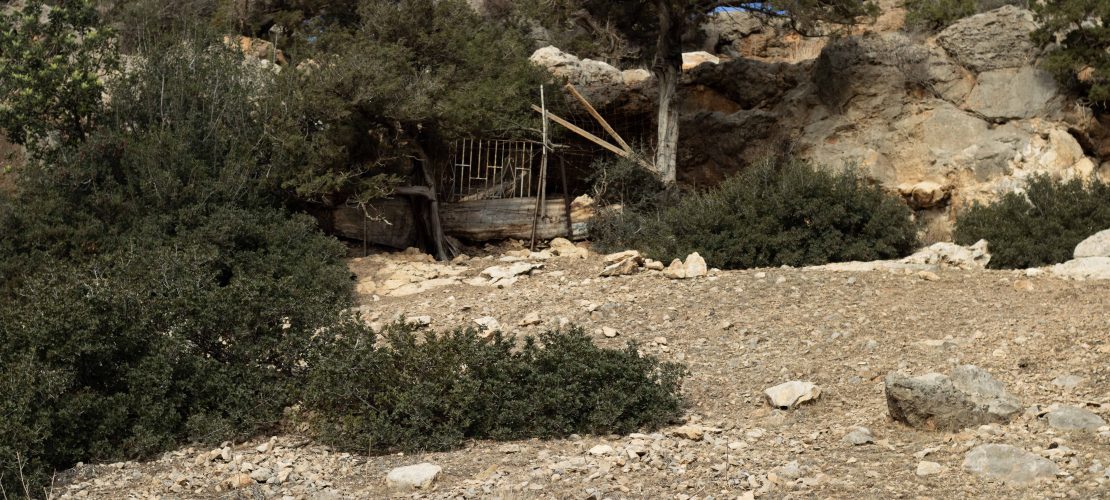
Hamza hates the city with a hostile intensity, and searches like a Bedouin for a white point untouched by any foot before. This point lives in his heart like a wound or a veil between him and Benghazi. I was observing him as we crossed the valley on our way to the Abou tamsa shelter. He was looking at the white stones at the valley’s bottom as a definition against sterile stagnation, and thinking of the water that rolled them along the valley as a poetic act. He looked at a tree that had been uprooted and thrown into the middle of the valley, and he tried not to cry from the intensity of its loneliness.
We walked searching for a reef that would take us higher, and we learned silence from the stones. We climbed up and he stopped briefly to look at the sorrowful sea water. The scent of the coast carried with it the image of a transparent homeland. Every day we climbed the mountain, the city would withdraw from his soul, as if in his veins ran the blood of a fierce animal biting the last remnants of the café table on Pepsi Street.
Behind us, the shepherd’s dog was barking madly, with a hatred devoid of all tact. The bark is the same thing, always the same thing, an image of illusion in the void, but the dog’s presence and the sound of the cows lowing served only to sharpen the edges of silence. Hamza raised a water bottle and took a sip, then looked upward like a bird wishing to return to its nest at the mountain’s peak.
The ancient geography was like a face of white bones hiding the world. But here in the valley, in the ascent and descent, and in the endless trails – geography itself is drawn to the poetics of eyes resting in the heart of the scene. We were ascending, and the Haua Fteah cave had become behind us like a sample of this poetics, insatiable for air and sun. In Haua Fteah, where we were yesterday, Hamza was running after the pleasure of primitive human rhythm, as if this cave were the womb of the world to which a poet, spat out by the city, returned to await his savage birth. As for me, I looked at it as a large hole from which the world’s first laugh emerged.
It is said that our ancestors emerged from the forest and advanced towards the savanna, and there they saw for the first time the earth stretching to infinity, tenderly touching the sky. They had to see the vast sky above their heads and the horizon at the end of their warm gaze. They had to do that to become poets, writers, and artists. Hamza, on the highway every day on his way to the Espresso café, leaves his wound on the side of the busy road, and thinks in the morning as he runs with his soft hooves over the Green Mountain. Images of caves and shelters crawl under his skin, and he remembers the grey color of houses without paint, the black power lines like an endless pot, and a clumsy, tattered tree that the wind hasn’t broken, standing on the corner of the coffee cup. Every time we are on our way to the café, I feel we are on our way to falling again into the pit of ashes.
Mohammed Abdallah AlThrhuni
writer and researcher
Share now: