
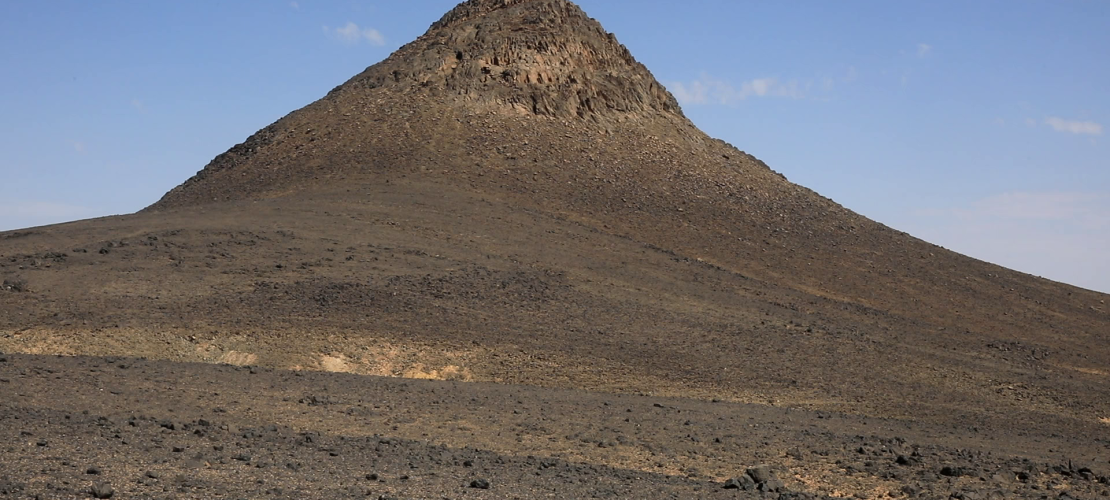
Mount Al-Qalib
A Legend Transformed into a Place
Article: Goepoetic, Mohammed Abdallah altrhuni
Al-Qalib* is a referential location in this text and points to a real place. What I will do is strip the realism from this place, which appears before you as a beautiful body of the idea of silence. Al-Qalib sits calmly in the midst of a rocky basin as mysterious as it is incomprehensible.
It is said that this mountain came into being in the form of a man walking on two legs, carrying his dream. When he grew weary from walking, he sat down and took on the dimensions of a stone mass. Over time, people considered it a rock that had suddenly emerged from the earth. But his dream was growing within him, and with it, the stone, until it became a mountain. Tales say there is a secret entrance leading to the time of the great African animals, and some stories say there is a passage inside Al-Qalib connecting it to the Acacus. But the mountain’s edges were narrating the time of water that preceded the terror of drought.
Hamza and I were sitting atop the peak of Shi’b al-Qulta, and we felt the mountain adjusting its posture to exert its hidden, secret influence upon us. It was on the verge of speaking to us of its solitude when we heard the voice of the stork engraved on a nearby stone, saying:
“This oval-shaped mountain once stood in the middle of a great expanse of water. In that period, it wrote obscure poems and learned from men sorrowful unto death how to paint its dreams upon the stones.”
At that time, the stones emitted a hum and a song, participating in rain rituals. Behind Al-Qalib lies Wadi Tajinat, which chews on rituals to create vortices of shamanic time, and Wadi al-Sarrat, where, when we were within it, we felt something weeping.
The people in Suknah speak of Al-Qalib with words as obscure as a shaman’s trance. They said they heard the screams of spirits emerging from the stones of Al-Qalib—screams that shake off the dust of sorrow and awaken the fog of calamities. They also said these spirits keep vigil, protecting the tomb near the mountain. Many of these people heard music and cries resembling the ecstasy of water. We heard many of these tales and decided to take the direct route to the mythical messages the mountain sends us from afar.
The stork was displeased with the tone of the stone that fell from an unknown hand. We sat with Al-Qalib directly before us, at a time when the sun was stumbling upon a final stone. Behind us was Shi’b al-Qulta, that stony memory of a devastating scene—this temple destroyed by an earthquake from the loud laughter of jinn, transformed into hundreds of scattered rocky streams. On a nearby rock, a bull reminds us of storms; on another, a cow reminds us of rain spray; and a mysterious man with a ritual mask dreams of promises that will never be fulfilled.
Many rocks in this reef, covered by dust, sleep on their edges where ostriches and the spirits of the dead lie. Al-Qalib gazes at the sunset, absent-minded, listening to the screeching of stones in Wadi al-Sarrat and the sound of primitive drums in the shelters, and the tragic stories of exploration that walk with the flowing stone like a river of dust: the story of that ethnographer who laid his cheek on the earth’s conscience and slept, and the anthropologist who took with him, on his return home, a wounded stone and a smile on his lips.
Even during that moment of our contemplation, it seemed to us that Al-Qalib was disturbed by the smoke from our cigarettes that filled its nostrils. So the stork spoke, as if speaking on its behalf, to address us:
“There is no incantation to rid the mountain of the paths of oblivion. There is no incantation that may rid you of the womb of stone growing in the hearts of men. Just like you, the mountain arrived carrying its dream. Solitude bewitched it, and it drank the water of the wild wind. Lo, you have become like a stone that suddenly emerged from the earth. I see you now, taking on the dimensions of a stone mass, transformed into a block of solitude rolling toward the passage that leads to eternal solace in the heart of a smooth stone.”
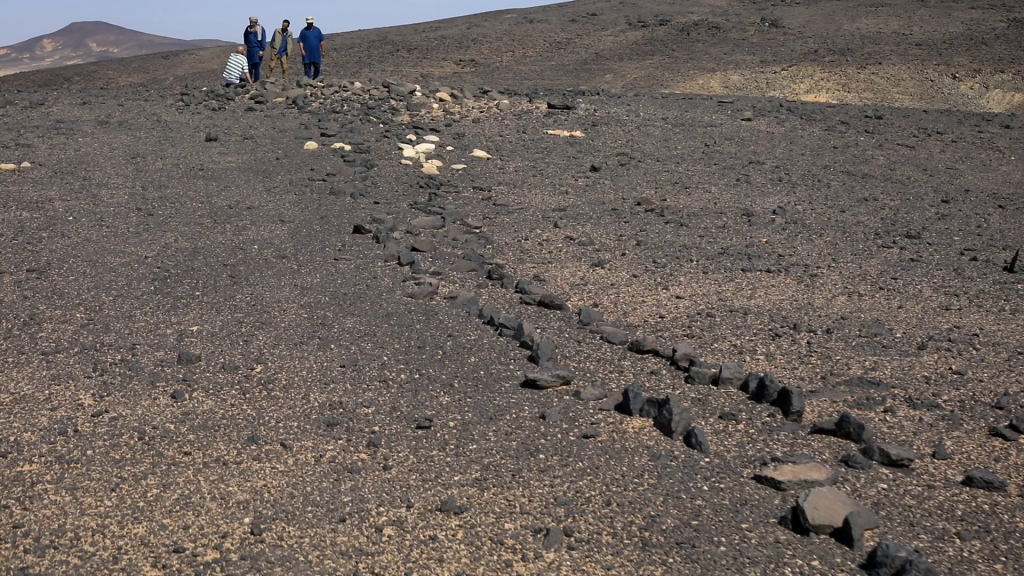
Tomb in the Mount Al-Qalib
Al-Qalib stands alone like a natural monk from whose eyelashes sleep has fallen, and with it, the dream of rain. Al-Qalib stands naked, and its words bow before the wind from the south of their own accord. The vast emptiness did not affect Al-Qalib, for it is always immersed in an indescribable dream. All it did was gaze at the stone fragments inscribed upon it and what remains of the earth’s aesthetics. Sometimes it blinks because of the sun’s sudden smile; sometimes it remembers its first sorrow, which appears as a glint of exceedingly complex meaning.
From the first moment we saw Al-Qalib, we felt it was a troubling secret buried within us because it opens onto other worlds and onto eras where ecstasy was infinite oblivion.
On our way back from Shi’b al-Qulta, we stopped at the tomb at the mountain’s base—a large tomb containing a double bed where a king sleeps, surrounded by the buzzing of stones. Emhamed turned over the stone beneath his foot, and we found on it an engraving of a gazelle searching for water in a time of drought. Hamza imagined that the sleeper in the tomb was the king of those who dwell in the sands—the Nasamonians tribe. He was smiling as he said, “The Nasamonians can breathe beneath the sand. Perhaps he is alive, and Al-Qalib is the open door through which he looks out at Libya. And when darkness falls, he goes to buy some small candles and curses this rusty womb in which he finds himself.”
The gazelle engraved on the small stone never left my imagination. There is more than a forgotten gazelle on a dark grey stone. There is a civilization staring at the sky while asleep with the king in his secret, secure tomb—a civilization of hills flowing in every valley of the desert, weighed down by gravity and the grimace of history’s closed shutters.
*Mount Al-Qalib It is a conical-shaped mountain, formed by the eruption of volcanic magma during the formation of the surrounding mountain ranges. It lies at the heart of a vast expanse where several valleys and mountain ravines intersect, becoming a prominent geographical landmark in the region—as if awaiting the arrival of the waters of Wadi Zaqqar, to gather them with the waters of the wadis of Sultan, Wuliyan, and Anqibu, and then send them collectively northward.
It is noteworthy that the people of the region anciently named it “Qulayb”, a diminutive of the word heart (qalb), symbolically denoting its central location, as though it were the pulsating heart of the place.

Mohammed Abdallah AlThrhuni
writer and researcher
Share now: