
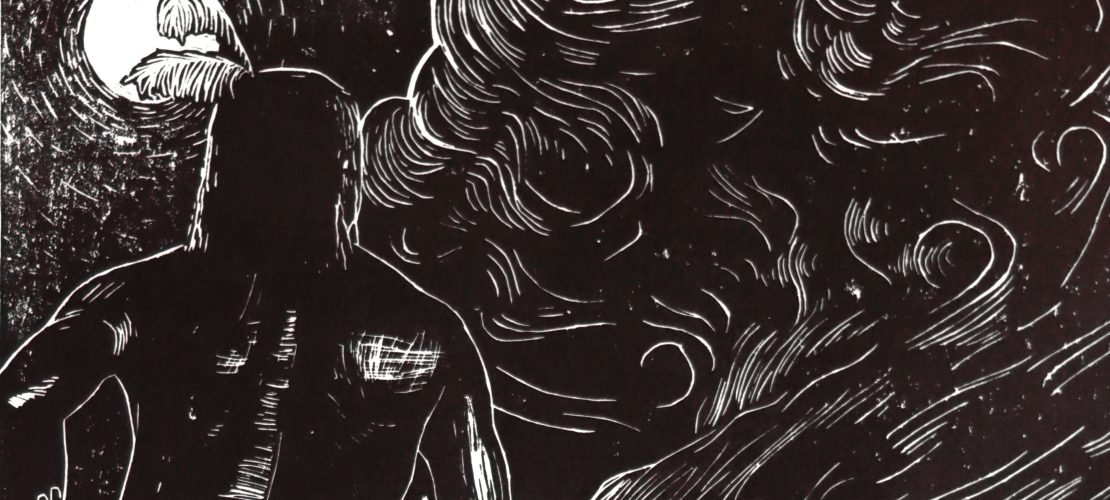
art work by shefa salem
Mirrors for Other Times
Article: history | hamza alfallah
Introduction
Journalist Stephen Schiff says, “At the heart of every good history, there is a small, cunning secret; it is good storytelling.” Good storytelling gives material warmth and embodiment, and the cunning lies in this tale having significance through which imagination acts as a mediator, protecting our memory from desiccation.
When narrating history, it is frustrating to content ourselves with merely enumerating the few chapters of events. This pushes us to constantly ask: How do the elements of the natural landscape want us to see them? In journeys, this question becomes akin to rearranging what was scattered in our imagination throughout the duration of stay and travel; for all that acquires meaning only by extracting the fine thread of details and pulling it to grasp a broader idea, to transform the story we have not yet written into a realm where times intersect. The rock art sites and their scenes in the succession of night and day, the caves and shelters, the valleys and ravines, the remote lands and sand dunes, summon in the space of our observation all the ancient symbols to be re-employed, or restored into a single fabric, without the voice of these elements losing its original intensity.
You sleep upon a night scene whose moonlight suggests only mystery in the eyes of wolves, and you wake to a dawn horizon wet with the last water of faint stars before the sun erupts, gathering the scattered fragments of these incomplete myths in your notebook while traveling, without embellishing their wild dance in the imagination. You walk and look at everything connected to the earth, and you see the ancient shepherd cleaving the valley with his staff, striking stones to make them resonate in the vessel of the past, while sounds transcend as if you are riding the wind beyond the layers of matter, searching for a disturbed and fluctuating zone for a boisterous writing, while all around you is silent. For in the invention of tales lies a mystery that tells everyone; you write nothing but what the forgotten signs on the roadside have told you.
The Libyan Shepherds and Tales of the Moon
Segment 1
Long ago, in bygone times, the moon engaged in a dangerous earthly game before he was worshipped. Women followed him, and because of his fascination, they would eventually transform into stars. He would descend the steep mountain ladders in the desert like silver dust, emitting astonishing melodies before reaching the earth, rolling a distance through the ravines, laughing recklessly in the bellies of valleys and dancing with strange insolence. In every descent he committed, he carried a small star in his hand, causing the stars to freeze until they became sad and cold in the sky, so that their burning radiance would not send a faint light to alert those who walked alone at night, enabling him to easily seduce whomever he encountered. For a period of time, he continued to abduct the emotionally broken, enticing the errant and those who rebelled against the tribe’s laws, planting in his dark space the ash of tragedy in the hearts of mothers who had lost their daughters, and in the hearts of men a bitter emptiness, leaving no trace, until his dominion grew even beyond that by disrupting menstruation, delaying pregnancy, causing miscarriage of seeds, and spoiling crops. The ancient tales of evil transformed into a single story about a courageous man with a compassionate spirit, who traveled at night to feed poor girls, cast magic into the eyes of unfortunate homely ones, and gently massaged the limbs of those afflicted with physical disabilities.
Throughout those ages, the moon’s greed in his youth never tasted the pleasure of having a single woman, nor did he learn in his illuminated theater to be anything but a hero who believed the lies fathers told out of fear for their children from illness and death. He was well aware that his legend would not end thanks to the old women’s deep faith that the abducted ones would one day return with long blue hair and silver feathers adorning their heads. In his old age, he once tried to practice his old habits, leaving a luminous ember of his skin after descending, but he failed to return again — naked and sick, he remained imprisoned on earth for several nights, unable to walk, until he despaired and decided finally to live among humans. He found no better disguise than the shepherd’s garment to be closer to the sky, after killing a shepherd from the Machlyes tribe[^1] and stealing his cattle and staff to offer sacrifices in hopes of regaining some of his health. And because he had not forgotten that he was once the moon and previously ill-reputed, he continued the life of a pious shepherd to purify himself and find a girl to marry.
The moon lived on earth longer than he should have, discontented. And because the ancient Libyan shepherds were connected to the stars[^2], he would sprinkle water in their manner before going out, and tap on the drum, his small weapon, to fight rogue spirits and protect his livestock, which had grown over time, from predators, caught between two worlds, carrying no certainty of anything’s fulfillment, until he fell in love with a distant star determined to make him taste misery. He left his herd and wandered far beyond the hills, pursued by beasts whenever he tried to hide, and stars never left his dreams: grey stars, crimson, golden, and green, but his playful red star was the only one with roots like fire pouring into his heart whenever he remembered his crimes. Between doubt and belief in his return, he believed his nightmares that promised him divinity and that he would not perish. Thus he kept dreaming of his savior star that would wake him at night, shivering from cold when he dozed, and this luminous madness of deception only ended after the old soothsayer revealed his secret before killing him during the sky-watching season, when shepherds gathered to awaken the stars with dance and kindling fires, saying:
“The sacred agate will not disappear, nor will the salt be poisoned tonight, and the promises of abundance in grass and rain will not be fulfilled. For what is celestial will remain deified and will not die, even if small, and what is earthly will live, destined for annihilation.“
The Wind is a Bird of Fire
Segment 2
It is said that the wind is easily annoyed, like a teenage girl who cannot bear her homework. In Bushmen folklore, those who have seen the wind say that it was originally an ordinary man until he transformed into a huge bird, without offering convincing arguments for his sudden change of nature; perhaps they avoided delving into this topic for fear of being uprooted by it.
Among the Bushmen, who never stop telling tales, there was one they called “the Men of Smoke,” the only one who spoke to the wind, and that its place was Mount Harvontin in a deep mountain crater. And because he was no less annoyed and displeased with it than it was with him, he would throw stones at it, believing it was a bird full of evil throwing fireballs to burn crops and huts, and because of that, it exploded and flew away, and has not blown gently since that day, becoming perpetually angry.
Since that incident, the Man of Smoke forgot the pleasure of lying down and sleeping like a child by the bushes, and remained fearful in his hut of restless dust—covering the cattle herd, sealing springs that knew nothing but tears. And because the wind is by nature untrustworthy in all tales, the Basili tribe[^3] also lost many of their men when it buried their wells with sand, so they decided to wage war with poisoned spears to kill it. But it was not a bird, but rather an anger from the hiss of burning sand grains they called Al-Qibli[^4], due to their repeated attempts to steal the sacred agate stone in order to control it. That was in a dry and strange time, when neither magic nor rain sacrifices had any miracles capable of controlling nature’s fluctuations, which had exchanged its fertile skin for dry crusts and a mournful whistle circling in the valley shelters.
Symbols
Segment 3
Since time immemorial, drought has been linked to longing, prayers, and immigration. And this is exactly what the man who lit the path to the water house used to do. And because the language of nature only communicates through symbols and signs, the San peoples relied on footprints and upturned tree branches to guide those whom the thirst of distance had led astray, or just to exchange messages and tell each other that they had simply not disappeared, as if saying: “We are fine as long as water is near.”
Thus, finding water was sometimes emotional and also technical, between the short-term surface movement towards pools by the San people, and the deep understanding of the earth and the engineering of time’s droplets by the Garamantian people[^5], who perceived the hidden secret of stability amidst drought, because they were simply, as it is said, born from the heart of the Qulta, and learned that the luminous holes of their ancestors in the walls send signals from their ancient shaman who crossed through them to the clouds to save his people. The descendants continued, until that time, to inherit the climbing onto the backs of ostriches and scaling the threads of light, until it was severed and most of them fell from the sky to the summit of Jebel Zinkekra[^6], and there they established their primitive fortress, before descending to Wadi Al-Ajal and commencing the cultivation of the desert, exchanging profitable goods and trade from the Proto-Garamantian period until the Classic Garamantian period.
And just as the water networks[^7] sprouted enchanting oases like a dream of immortality, they also sprouted long annihilation on bridges of bones. And men, due to traveling long distances, continued to engrave their chariots and horses on mountain edges to determine the routes to reach gold, minerals, ivory, and precious stones, to ensure for their kings in another life comfortable tombs teeming with the finest funerary goods.
[^1]: An ancient Libyan tribe, dwelling in the far west of the Libyan coast, their territory extending to the great Triton River.
[^2]: Ancient shepherds were existentially connected to the sky; by it they guided themselves in travel, and regulated the seasons of rain and fertility, so stars became a system of knowledge before being an object of veneration.
[^3]: An ancient Libyan tribe, known for their veneration of snakes and their war with the Al-Qibli wind.
[^4]: A hot, dry wind that blows in Libya coming from the depths of the desert, with which temperatures rise, drought intensifies, and it sometimes carries thick dust that obscures vision and increases the feeling of suffocation.
[^5]: An ancient Libyan people who inhabited Fezzan in southern Libya, and flourished between the 5th century BC and the 5th century AD, taking Germa as their capital.
[^6]: A mountainous site in the Fezzan region of southern Libya, containing remains of ancient settlement attributed to the early stages of Garamantian presence in the area, archaeologically known as the Zinkekra fortress, which has a defensive character linked to the urban center at Germa.
[^7]: The Garamantian water networks relied on the “Foggara” system; underground channels dug with precise slope to transport water from aquifers to the oases, enabling stable agriculture in the heart of the desert around Germa in southern Libya.
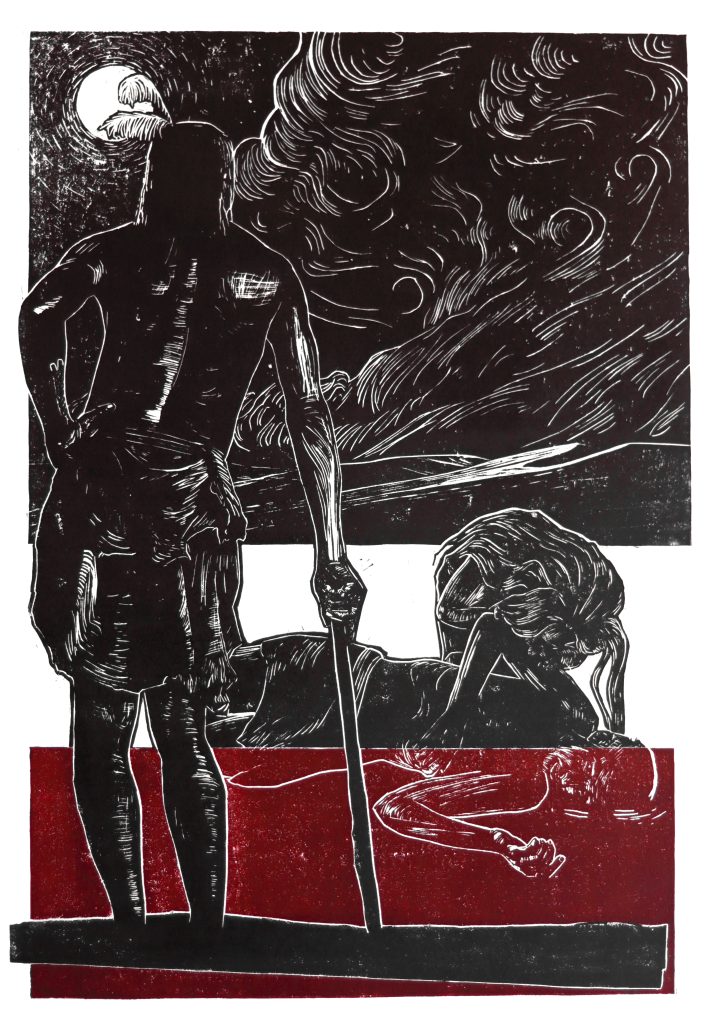
art work by shefa salem

Hamza alfallah
writer and researcher
Share now: