
In the horizon, everything is possible*
Article:Land-Attached, Hamza alfallah
At night, meaning draws closer to revelation before the long dialogue of day. Words in the darkness of Wadi Tajent grow colder, and emotion is less painful in fleeting glances that rest without alighting on anything—Is it true: “When man could no longer contemplate, did he begin to think?”1 Amidst the majestic silence of the open wilderness, Mohammed Bukhzam was stretching his body on a humble mat, leaning against a small cushion, and with a thin, dry twig, he was drawing circles and lines in the sand that I had discerned the moment we arrived at the valley. These lines and circles seemed akin to the confused imaginative movement of the shaman after returning to the walls of the deep valleys surrounding the city of Sokna. And because Mohammed was not contemplating but thinking inwardly, as if moving from one point to another while at the heart of the external space, the profound darkness that had soon peeled away from the rocks upon our arrival easily swallowed him.
Mohammed raised his head towards the car headlights and swiftly turned his face away from an artificial light that did not harmonize with the silver twinkle of the stars shining in his eyes. Even then, we had not yet felt that we were approaching being those intruders who break a person’s solitude and traverse distances aimlessly merely for leisure and drinking tea. But we recovered from standing at the brink of the awkward zone of being mere interlopers seeking idle chatter, after the drivers turned off the engines so we could restore the purity of silence and personal peace to this “land-attached one.”
Outwardly, he had seemed to me in harmony with the still night scene, yet the clamor of thoughts in his head was distancing him from the privileges of contemplating the surrounding elements. No doubt, with his intense and absent-minded concentration, he was crafting his own internal scene, thinking how moving from one rock to another is astonishing and smooth when he first immerses himself in the maps of his dream before embarking in the morning on his tasks and what he was accustomed to doing in the real path since he was a small child gathering truffles*. On the road before arriving, Al-Tarhuni had posed an inspiring question about what nature means to the land-attached person? The answers revealed the extent of our feeling of life’s melancholy in our rooms under economic light bulbs, and because the horizon began to blend with the remnants of the sun’s extinction and the first shadows—we contemplated—without thinking about the color of the sky, and the familiarity of warmth seeping into dreaming eyes.
In the natural landscape, the elements become more pleasurable, even if it is a harsh desert, and this pleasure can only be sensed in the company of the land-attached person. Because he simply teaches you how thinking harmonizes with the body’s movement in space: cautious climbing, the precision of foot placement on rocks in the valleys, the sudden stop and contemplation of the sad sunset due to its slow fading, sitting beside the scattered graves in the north and west of Sokna, the small stone cones* on the edges of Wadi Al-Sart, tasting plants of various kinds*, joyfully reciting the names of birds* when they alight near you as a happy surprise—all this and more, its euphoria can only be felt while following the land-attached one to rare sites.
At night, after we arrived and drank tea, Mohammed began telling us about the types and numbers of graves in the area, the strange types of stones he had collected throughout the distances he traveled, and about all the shelters that witnessed the first breaths of human existence with all its pains, joys, rituals, and stone tools crafted to sustain life.
Our passion for formulating a concept of our own about the land-attached person is far from the notion of transient tourism or European curiosity-driven travel. Rather, it is a passion stemming from a long history forged by these men whom the Libyan desert has known. This concept aligns only with viewing the land as a realm for pondering a language that does not speak to us of terrain merely as forms resulting from internal and external geological interaction, but by looking long at the hidden space of identity between matter and meaning, and at the neglected memory within all Libyan rock art sites of our history as an intimate ruin that was breached by the Other without placing it in its context. Today, we need to restore it carefully, stone by stone, with the eyes of the writer-explorer and the land-attached one who possesses nothing but these valleys.
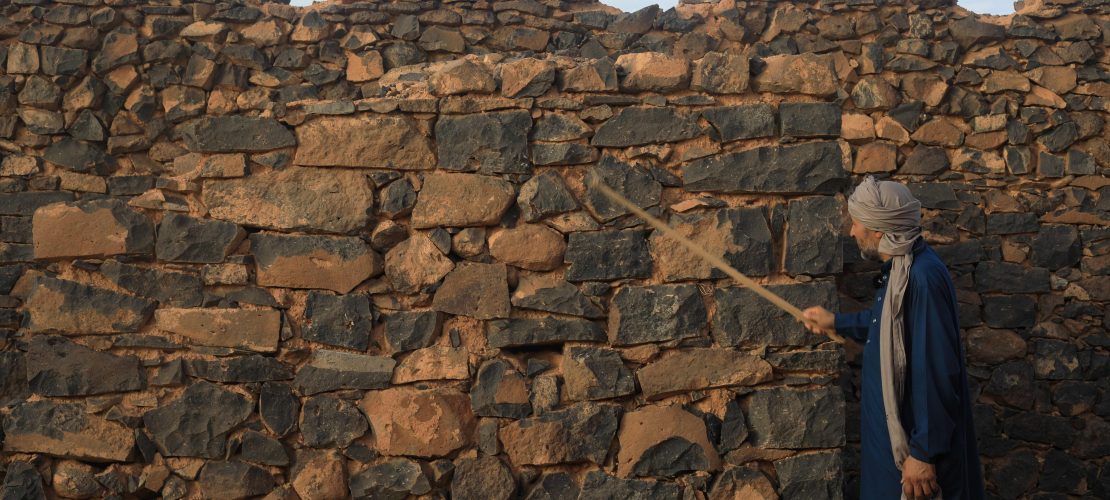
I, and before starting work in the valley in the morning, was contemplating the looks in Mohammed’s eyes at everything around him during his talk, driven by a wild urge to walk in order to write a letter to the basalt stones we walked upon a few days earlier on the flat expanse* for long distances—a letter carrying a sad longing for a grand, dreamlike world as Bachelard tells us in his book The Poetics of Reverie—a world where nothing happens due to the intensity of its magic in all those dry spaces submerged in shining blackness—that mute color of excessive beauty.
*The title of a poem by Pierre Chabot, published in Les Cahiers de Nougat, May 1959.
1 Gaston Bachelard, The Poetics of Reverie: A Poetics of Daydreaming, translated by Georges Saad (Beirut, Lebanon: University Foundation for Studies, Publishing and Distribution, 1991).
*Terfess or Truffles: A valuable and rare type of desert fungus that grows underground after rainfall. It resembles a potato in shape and is used as food.
*Akwaaz (stone cones): These are semi-pyramidal tombs consisting of small piles of stones scattered throughout the entire region.
*Numerous types of plants were recorded by us, including: Al-Maknan, Al-Shaqara, Al-Humayd, Al-Ghurayra, Al-Lislas, among other varieties.
*A number of bird species exist in the region, and we recorded some of their names: Al-Bughrir, Al-Bubshir, Al-Ablaq, Al-Baqirma, Al-Qata, and Al-Hubara.
*Mastah: This refers to a vast expanse of basalt stones on the summit of the Black Mountains.

Hamza Alfallah
Writer and researcher
Share now: