Because We Are Where We Do Not Exist
-Pierre Jean Jouve
Article: Land-attached, hamza alfallah
My interview with Abdul Latif al-Mahdi, and my question to him about solitude, was a strange matter for him. In turn, his astonishment at this question preoccupied me greatly. That night, while trying to sleep, I thought about my position as a writer accustomed to the life of rooms and crowded city streets, as if a barrier existed between me and Abdul Latif that must be shattered.
In the morning, before we prepared to go to Shi’b al-Qulta with him, I woke early to observe Altrhouni outside with his cup of coffee, lost in thought. Because he didn’t move a muscle except to raise his cigar, his silence felt like a freedom from behind the narrow words. He paused for a moment, then looked upward, beyond the wall of the rest area, and softly recited, like a sad migratory bird, short lines by Jean Tardieu: “To advance, I walk my tedious routine, a whirlwind haunted by stillness, but within me, there are no boundaries anymore.”
Boundaries, yes, those are the boundaries Abdul Latif does not know. When I asked him about solitude in the valley, he considered this word bad, touching something of narrow-mindedness, a word that knows no mercy if it consumes its bearer. Therefore, I had to step out of the city’s circle and its rigid concepts into the moving space to understand the earth-attached person and how they think. The earth-attached person has the elegance of their myth, formed from the elements of the natural landscape: mountains, trees, stones, plants in wall crevices, birds, sand, and black rocks. And in Suknah, the elements of this myth had their flexible words about the real place out there. In the city, the ‘there’ disappears—that distant, excessively human place where the soul does not lower and fall, but rises every time we ascend a reef in Wadi al-Sarrat, or climb rocks in Wadi Tajent.
After minutes of contemplation, I went in to get ready. I found Altrhouni standing over Issam, who was in pain from his knee and refusing to go out with us on this tour. The insistence and the spark flying from Altrhouni’s eyes were turning into a gloomy ash of despair over losing the only photographer who had been accompanying us on this trip. At that moment, the discussion froze. Altrhouni, visibly angry, directly pulled the small camera from the bag and pushed it towards me, saying: “You must take over this task. I will not leave Suknah before finding those rock inscriptions we didn’t document last time.” I remained silent without comment and looked at Issam, curled up like a useless piece of junk on the bed, with all of Sisyphus’s curses for the world on my tongue. How could I describe my state then? We had been, for about two days, on a strenuous trip to Wadi al-Sarrat to inspect the Garamantian tombs—a tour that lasted, walking the length of the valley back and forth without camping, for six hours or more. Yet, I agreed with Altrhouni on the necessity of finding these inscriptions and benefiting from Abdul Latif’s expertise to locate them.
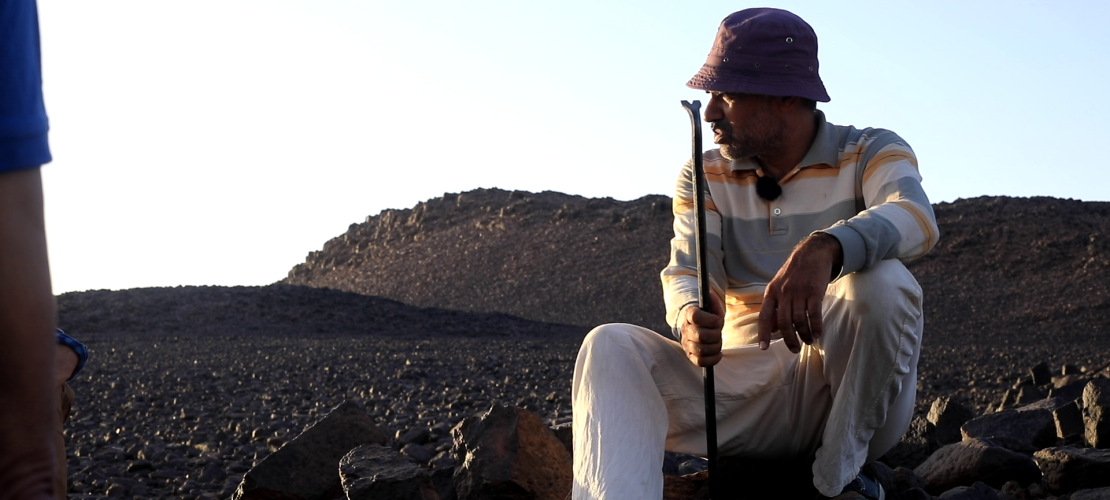
We set off after Abdul Latif arrived in his car. Throughout the journey, the conversation never strayed from the land, even as we crushed the bones of rocks with the car’s wheels. We descended after parking near the reef, with al-Qalib directly in front of us. Abdul Latif took out a long iron rod, tossed his phone aside carelessly, and we began climbing until we reached the summit, where a group of inscriptions awaited—we found some, while others were extremely difficult to locate. But attachment to the land grants the senses another shape, from unseen angles. Abdul Latif was feeling the stones, smelling the soil, speaking only out of necessity or to inquire about matters Altrhouni had previously discussed, rarely looking back, as if the expanse of the land was whispering to him of a promised paradise, like a lake of mirage, whose shade he would reach soon.
Walking is the logic of thought for the earth-attached, and observing space is nothing but an intimate dialogue with the pleasure of gazing at the risks of ceasing to feel, or a call that rises with love like the arm of a mature tree embracing the dome of the sky. We moved without stopping from one natural idea to another, pulling the scene as it suited the movement of the soul, not the body’s performance—the soul that is aware of that distant ‘there’. “For outside, everything transcends measurement. And when the level rises outside, it rises within you too. Not in your veins, which you control only partially, nor in the phlegm of your stiffest organs: but it grows in your capillaries, pulled upward, to the farthest branches of your infinitely branching existence. Here it rises and flows from you, higher than your breath and as a final refuge, you settle as if settling on the edge of your breath”1.
The earth-attached person has the voice of a geography we didn’t learn in schools when we used to look blankly at textbook maps. We were children who didn’t know that the colors of nature need emotion in art class, and that words need more than nostalgia to express what is missing in us. But the earth-attached person, while immersed in the natural landscape, has all the colors of the world standing beside them, and childhood never leaves them as they examine every small grain of sand, pebble, and vein wrestling with drought, searching in silence for the single word—not the expression lesson we used to escape to without understanding it—that word which is not said and can be easily forgotten while in an eternal embrace with the earth.
Near piles of rocks, Abdul Latif sat down, not to rest, but as if he was collapsing before me from afar like a leaf in the wind’s mouth. He was extremely despondent. When I caught up to him, I asked him the reason for his sudden stop! He told me he feels fear for the entire region. “But fear of what?” I said. He was silent for a moment and said:
“In this age, nature here has become too weak to recover any of its former splendor, under the tyranny of this arrogant and changing climate, amid the growing neglect like a spider weaving its web. There are no development or protection projects for our historical properties that you see from the vandals and thieves. Do you hear this silence enveloping us? It is nothing but a gradual fading of life and a slow death consuming the soul. You asked me yesterday about solitude, and I told you that our solitude as earth-attached people is not the solitude of monks in cells, but a solitude of the nomadic wandering of thoughts that never rest about the fate of all the innocent trees that have vanished, and the delicate lakes that once surrounded al-Qalib, this mountain whose summit tells me of the first rituals of grass, and of the rampant hunting of animals whose eyes’ glint in the sun gave their disappearance a sad scent I smell every time I travel long distances daily to check on the last pulse of the stones.”
Amidst the emptiness, despair had completely taken hold of us near him. We felt that this earth-attached person desperately needed to finally speak all his obsessions at once in a remote, distant space, as he turned the elegy of stones between his fingers. The land, which had withered slowly, was speaking through him with immense simplicity, confessing to us in the end that since this earth-attached person was born near the valley amidst a herd of goats, and the roots of plants taking shelter near refuges dwell within him, and that his hot sighs are nothing but that orphaned exhalation of a fleeing gazelle fallen slain with its hot blood by the reckless muzzles of hunters’ rusty rifles.
1 – Gaston Bachelard, The Poetics of Space, translated by Ghaleb Helsa, 3rd edition (Beirut: University Foundation for Studies, Publishing and Distribution, 1987).
Hamza alfallah
Writer and researcher
Share now: