
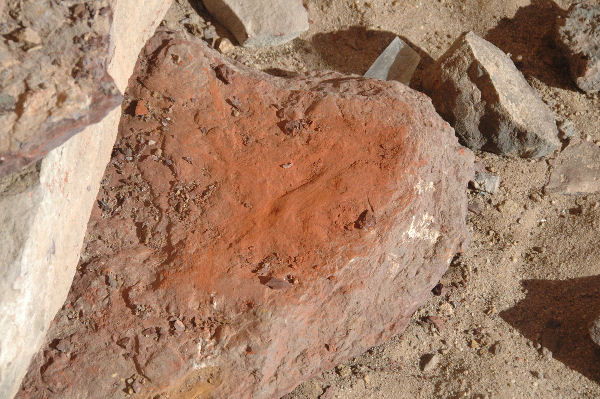
Wadi Awis ©Jona Lendering
The Use of Colors in Rock Art
Artical, Ethnography | mohammed abdallah altrhuni
What is ochre? Ethnographically speaking, ochre is the most commonly used pigment in rock art. It is a general term applied to any iron-bearing soil, clay, or rock containing a sufficient amount of iron oxide or iron hydroxide. Ochre was first used in Africa and became part of the symbolic context in rock art. Ochre is found in rock art murals, in burials painted with ochre, and on ostrich eggshell beads. However, in our archaeology, it has been neglected, its importance downplayed, and considered unworthy of mention. Archaeologists excavate searching for specific answers, but they have never considered answering why humans chose to use red, yellow, brown, and other ochres in their symbolic practices. What ethnographic ideas can ochre and other pigments present to researchers today? Why is a specific pigment used for particular murals over others? For what reasons does one color recede to the background of a scene, while it was once the most used or significant? Perhaps the use of certain colors ceases due to climatic conditions; in arid regions, specific colors are used, while others are used in humid regions. Perhaps the use of certain colors changes due to migration or a change in dwelling place. Also, chronological and stylistic sequences can be understood through color changes from one period to another. All these ideas and more make ochre and pigments of extremely high importance in rock art studies.
In an article by a group of researchers, including di Lernia, titled *“ Colour in context. Pigments and other coloured residues: from the Early-Middle Holocene site of Takarkori (SW Libya) “ *, we find confirmation of “a group of colored archaeological remains dating to the Early and Middle Holocene.” Strangely, this particular shelter contains not a single mural. In this regard, the article indicates that ochre mixed with other elements could be used as medicine, as a paste for hafting stone tools and repairing wooden tools, and prepared (often mixed with butter or milk) to protect or decorate hair and skin. Regarding the use of ochre in burial, the article points out that it is a well-known cultural custom from Pleistocene and Holocene contexts in North Africa. Analyzes conducted on Acacus murals have proven the use of organic materials (mostly proteinaceous), identified as egg and blood serum. As for the pigments in the Takarkori shelter, the presence of ochre and colors was confirmed: red, yellow, white, orange, and pink… Some traces of pigments were found on stone artifacts and other objects such as bone, wood, and ceramic tools (Figure 1). Amidst much speculation, the article concludes that the most likely explanation for this vast quantity of colored remains is indeed for painting rock art murals. Despite the article’s focus on determining the molecular elemental composition of pigment residues at Takarkhori, it remains merely a characterization of paints, pigments, and binding media; the ethnoarchaeological method was not used to understand and interpret the symbolic use of these pigments and their role in the murals.
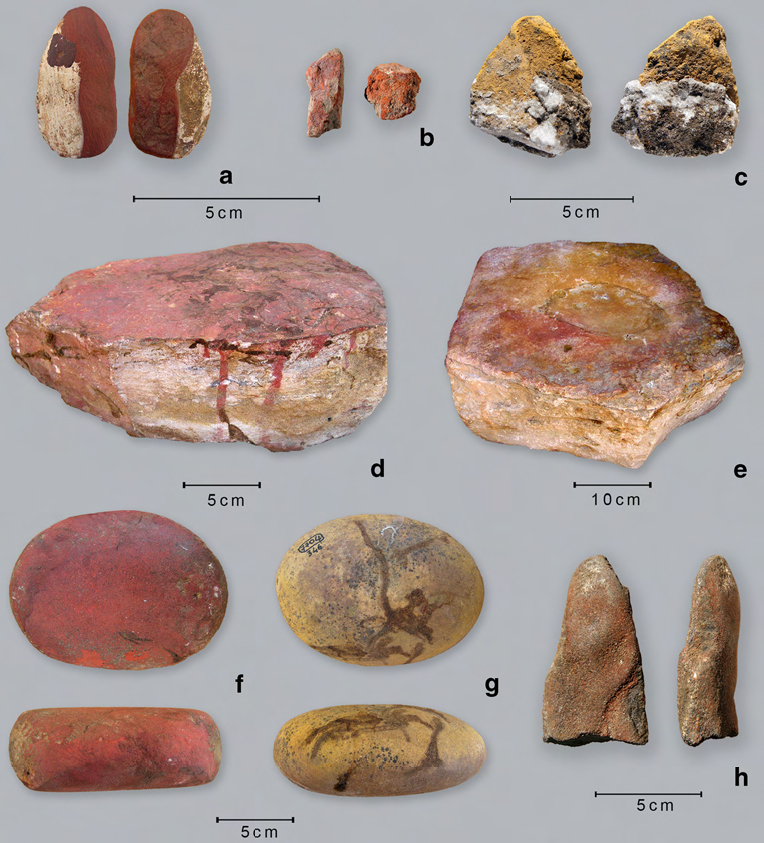
1- Photo by S. Giovannetti
Standard color charts were used for fear of employing subjective terminology to describe colors, despite the difficulties associated with using these charts due to the impossibility of accurately reproducing colors. The Munsell Color Chart has been challenged for excluding other phenomena that affect color classification in diverse contexts. Add to all this the use of foreign concepts for colors.
Undoubtedly, the use of colors in rock art is done in a preferential manner. The San people, as Woodhouse states, “The colors of the paintings are inspired by the natural colors of the earth. The most common color is red, ranging from pure bright crimson to a shade approaching purple. White and black are very common. Yellow, orange, brown, and pink are somewhat less common (Figure 2). A rare color is blue-grey, which appears occasionally, and green is absent.” This can be explained by the desert environment in which the San people lived, especially since Lewis-Williams views rock art as an attempt to control the environment.
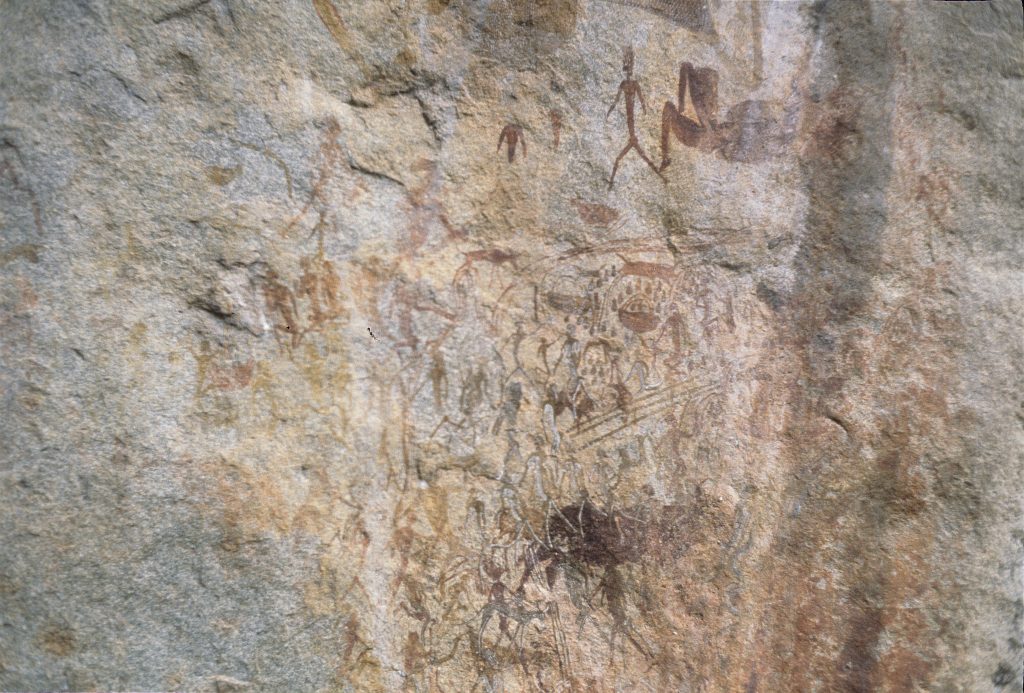
2 photo by Steve Tatum, South Africa
Therefore, rock art murals are considered a self-aware ethnographic record. It can be said that red is the most common color in African rock art, and this applies to rock art in Libya. Red has a long history in Africa and lies at the heart of human symbolic behavior. There is crimson red, clay red, and reddish-brown in most Libyan rock art paintings. Perhaps the importance of this color is linked to fire as a supernatural power symbolizing transformation and passage. Congo tribes paint themselves with red at the end of isolation periods associated with rites of passage. Green has only appeared in a few Libyan rock art paintings (Figures 3-4). Blue is completely absent, possibly due to the difficulty of extracting plant-based pigments like blue and green. White in rock art is considered a veil or a dividing boundary for entering and exiting the material world into the spirit world, and it is usually found in Libyan rock art as an outer outline for figures, representing the divider between the two worlds (Figure 5). Among the San people, the person emerging from the rock surface is painted white.
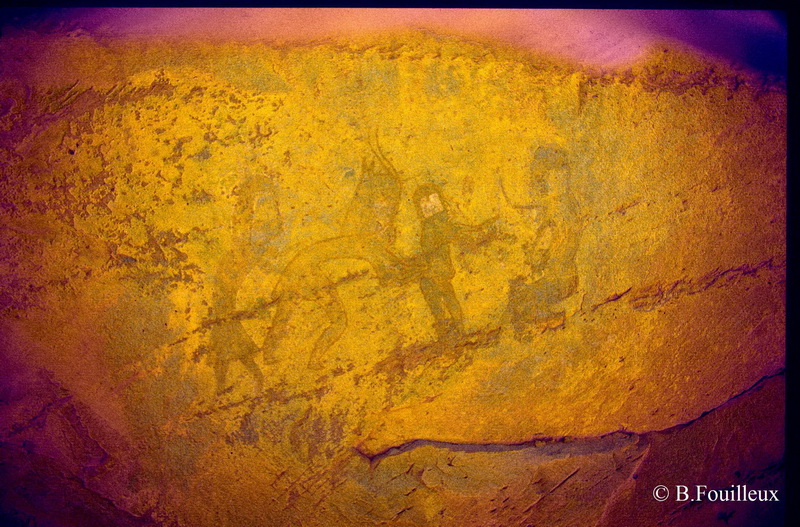
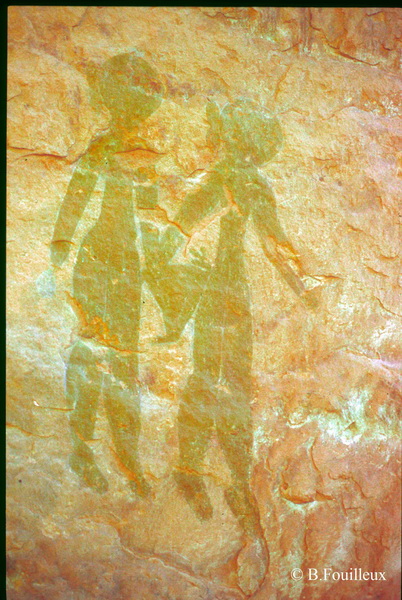
3-4- photo by B.Fouilleux, Uan Tamauat (left), Afozzigiar I(right)
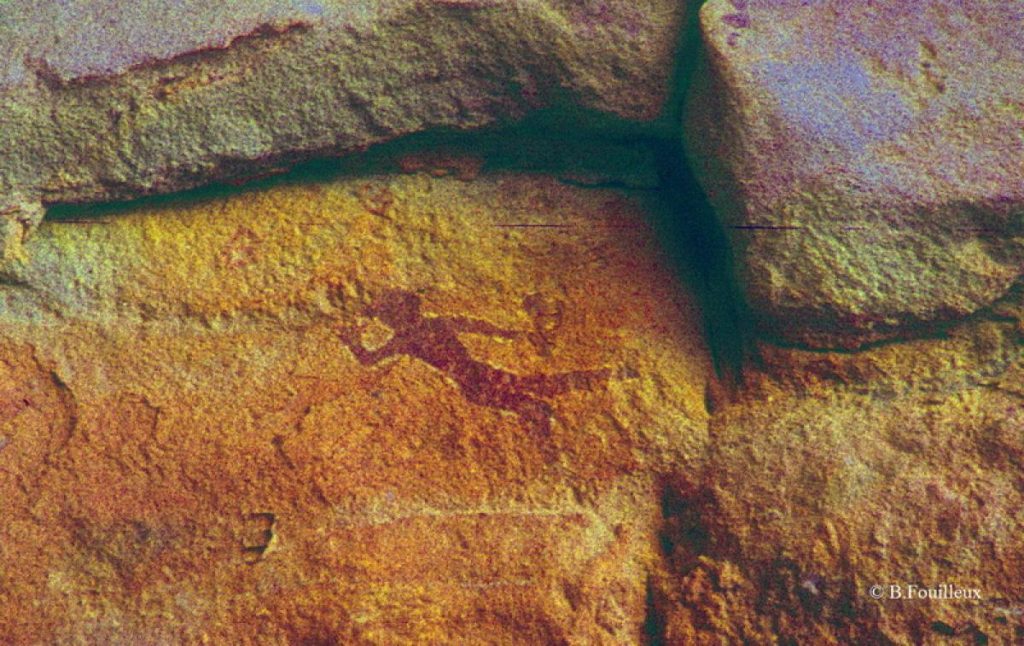
5- photo by B.Fouilleux
Ochre and pigments were used as a symbolic medium in the Pleistocene and Holocene. Before that, in very early rock art, form was more important than color. But what prehistoric humans understood was that colors have an emotional value, whereas forms do not carry such value. This emotional value, over time, transformed into symbolic behavior and cognitive complexity; indeed, colors became a communication tool, carrying the symbolic message of rock art. In Wadi Awis – Acacus, there is evidence of color mixing before application on the wall. Despite the ease of obtaining yellow ochre from clay rocks, and that colors like white and black do not require extraction and come from other materials—white from bird guano, and black from charcoal, and thus they do not occupy a wide space in the paintings—red dominated the entire African continent. In the attached table, prepared by artist Shefa Salem specifically for this article, we see this dominance of red over the other colors. But this occurred in the Holocene period, not before. Drawing in prehistory was a ritual, and colors had special power; colors often enhanced the magical and spiritual character of the paintings. Our lack of knowledge about the importance of ochre represents a very significant cognitive gap. There is not a single study, to my knowledge, that establishes ochre as a cultural practice, and that its use indicates human evolution and is linked to the development of rituals. Perhaps this is the first time a chart of Libyan rock art colors has been compiled.

table 1 – shows the commonality of using specific colors in Libyan rock art.
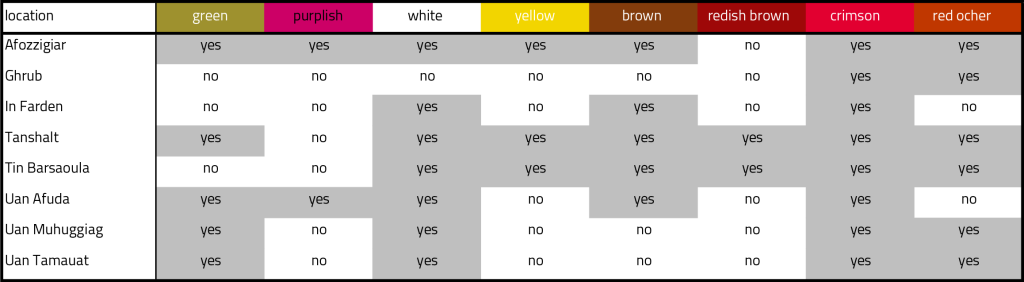
Table 2 – shows the colors used in some examples of Libyan shelters.

Mohammed Abdallah AlThrhuni
writer and researcher
Share now: