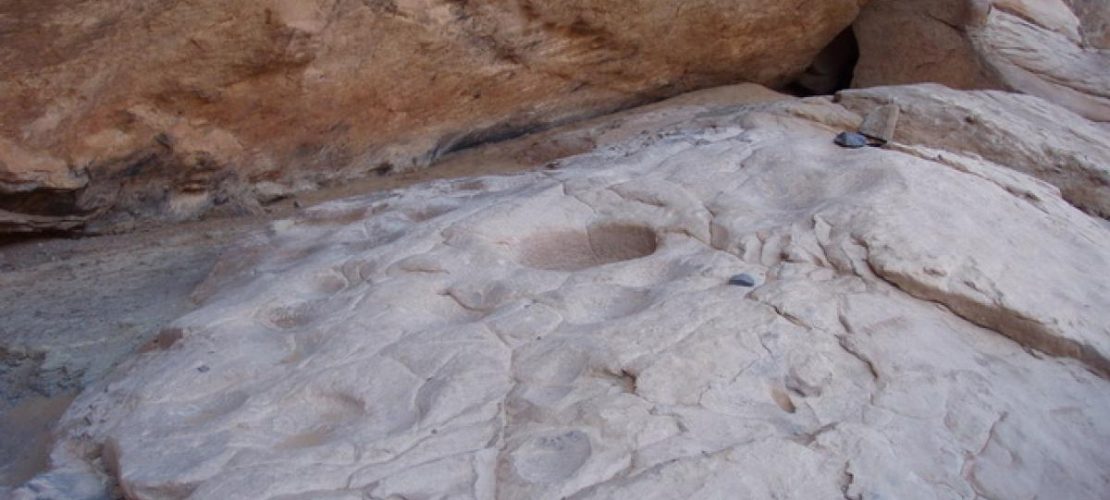
The Water Hole
The Emotional Interaction Between Humans and Al-Qultah (Kettles) in Prehistoric Times
Article: Archeaopoetic, Mohammed Abdallah altrhuni
Archaeology has long searched—through the tunnel of eternity, with an almost unbearable bitterness—for a way out of the traditional understanding of the archaeological site. There is also a serious quest for a new narrative to replace the old one, which archaeologists have constructed from the material remains of the past. In this search, attention must be paid to archaeological places themselves, not merely the material remnants. In the Archaeo-poetics we have adopted as an interpretive method, place assumes its full importance and presence. It is the place that contains the prehistoric human experience. No one disputes that archaeological sites possess a mysterious energy, a radiant power specific to the beliefs and rituals once held there. From my own experience, I cannot help but speak of this energy particular to an archaeological place. Sometimes, upon entering a cave or shelter, you feel a sharp creak within your soul. At other times, the feeling is vague, tinged with a faint dread. There is no clear dividing line in archaeological sites between wonder and fear. We must understand that standing in an archaeological place means establishing a connection to the history of that place and those who lived there. The strength of this connection depends on the power or fragility of your own spirit when confronting the distant past. Your archaeological knowledge can also intensify the weight of sorrow you feel while sitting in such a place. Many people visit archaeological sites searching for a stone arrowhead or remnants of human bones, but, more profoundly, they seek a connection with the energy that the ancient stones seem to sing. These places suffer, groan, and laugh—you feel this unfolding and opening within your soul as you sit in a cave that has been haunted for thousands of years.
What most struck me, in the places I have visited or come to know through images, is the presence of Al-Qultah (Kettles) in the same location. This is not unique to Libyan rock art or even to Africa; worldwide, Al-Qultah (Kettles) appears as an element in nearly every place inhabited by humans in prehistory.
Amidst the rises and falls of the terrain, space appears as a shimmering, celebratory movement. If this movement ceases, place emerges like a dream’s thirst for incompleteness. Prehistoric humans felt a familiarity with their surrounding environment, but the central point was always the dwelling—the shelter they lived in. From this shelter or place, they perceived the features of the surrounding space, bestowing upon them complex yet resonant names. Rock art emerges within the triangle of earth, sky, and water. This is the natural place, not yet the cultural one we understand through our interpretations of symbols. A place becomes cultural when something is painted or engraved on its walls, or when a Al-Qultah (Kettles) is carved into the rock, whether inside or outside the shelter.
There is a profound connection between water and stone, despite their apparent contradiction. Water is movement; rocks are cessation and stillness. Yet, it is the rocks that determine the points of water and their spatial distribution. Prehistoric humans understood this link and carved Al-Qultah (Kettles) near water sources, places that marked the surface availability of water. They understood the movement of water as a matter of life and death. Religious beliefs worldwide are connected to rain and water generally. During harsh periods of drought, prehistoric humans invented myths and symbols around rain. These myths and symbols transformed into paintings and engravings on walls, and into the carving of rocks to create what we today call Al-Qultah (Kettles).
Many wonder: why did prehistoric artists choose a specific wall to paint on, perhaps ignoring another, seemingly better wall nearby? The answer lies in the cracks within the wall—they were the places where spirits entered and exited. Others question the association of rock art with the presence of a nearby Al-Qultah (Kettles) (Figure 1). The Al-Qultah (Kettles) is the water hole from which the shaman departed on his journey to other worlds. When he died, his heart fell from the sky like a star, transforming into a new Al-Qultah (Kettles).
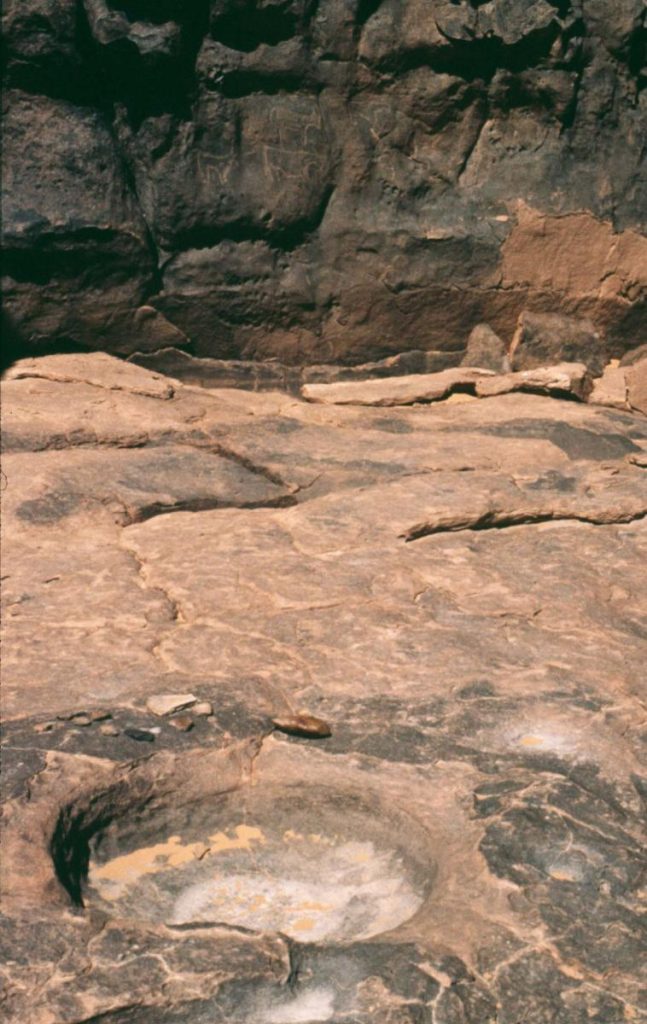
Figure 1
Lewis-Williams states: “Shamans often experience feelings of darkness and constriction, sometimes breathlessness, mimicking entry into an actual hole in the ground.” Al-Qultah (Kettles) is the point of departure for the shaman to worlds where he encounters spirits and other shamans, engaging in battles to bring rain and heal the sick. But even before I knew all this, I noticed that Al-Qultah (Kettles) was not merely a hole in the ground. Prehistoric humans carved Al-Qultah (Kettles) into shelter walls. In (Figure 2) from Tassili, we see a Al-Qultah (Kettles) carved into the wall, with a figure below it. Water could not possibly have flowed down from this Al-Qultah (Kettles) carved into the rock. More likely, it was carved onto a fissure from which water once trickled. In Uan Afuda – Acacus (Figure 3), there is a Al-Qultah (Kettles) painted as a circle on the rock, with water descending from it. This water, too, does not appear real; it is painted on the wall like the other figures.
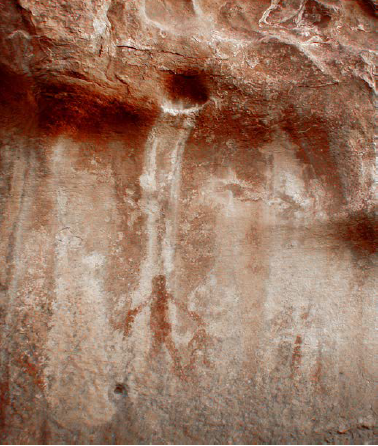
Figure 2 ©Jitka Soukopova
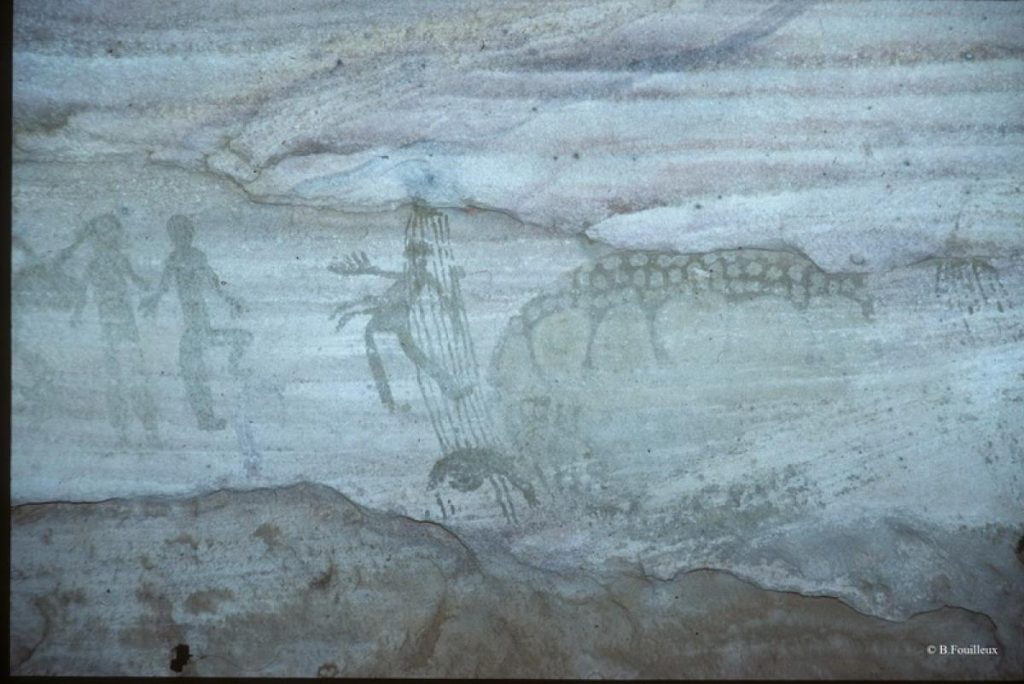
Figure 3 ©B.Fouilleux
In Ghrub – Acacus (Figure 4), a Al-Qultah (Kettles) is carved into the rock in the form of a water spiral. Again, water could not have flowed from this engraved rock art panel. Even in the earliest forms of rock art in the Acacus (Figure 5), a very primitively engraved figure is shown forming a Al-Qultah (Kettles) with its feet, and the figure to its right also has a Al-Qultah (Kettles) beneath its feet. In Afar – Acacus (Figure 6), there is an engraved Al-Qultah (Kettles) with a figure below it whose body has transformed into a Al-Qultah (Kettles), and beside it, a rain animal is depicted inside the Al-Qultah (Kettles). All these murals were engraved in places where no water exists. If water were present in these locations, it would only descend from cracks in the wall, not from a Al-Qultah (Kettles) carved into it. So, why carve a Al-Qultah (Kettles) in a place where water would never collect?
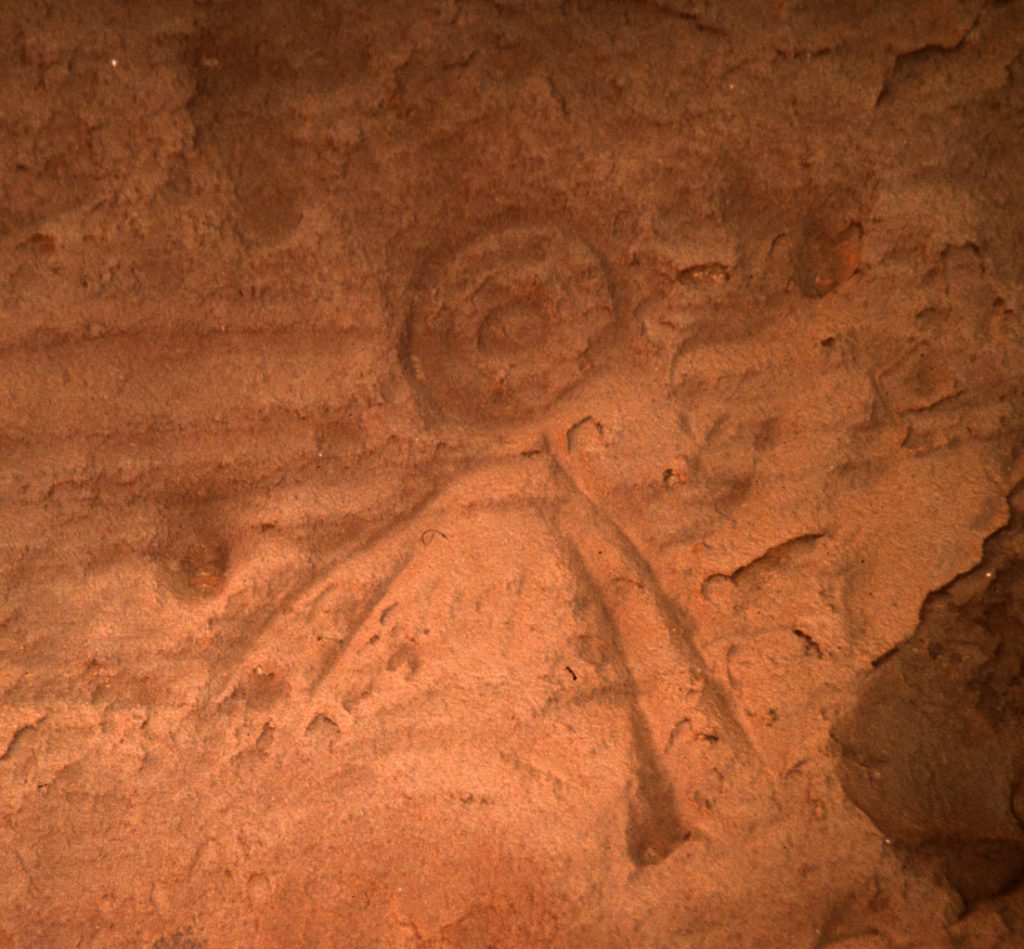
figure 4 ©B.Fouilleux
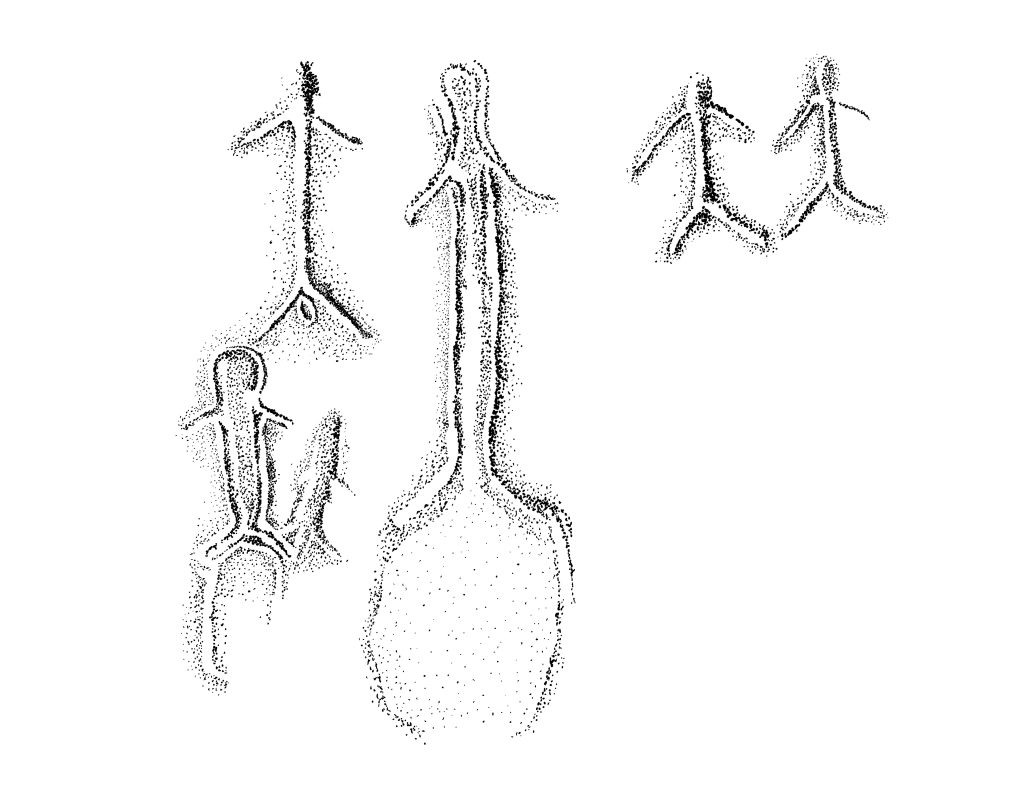
Figure 5 ©Shefa salem
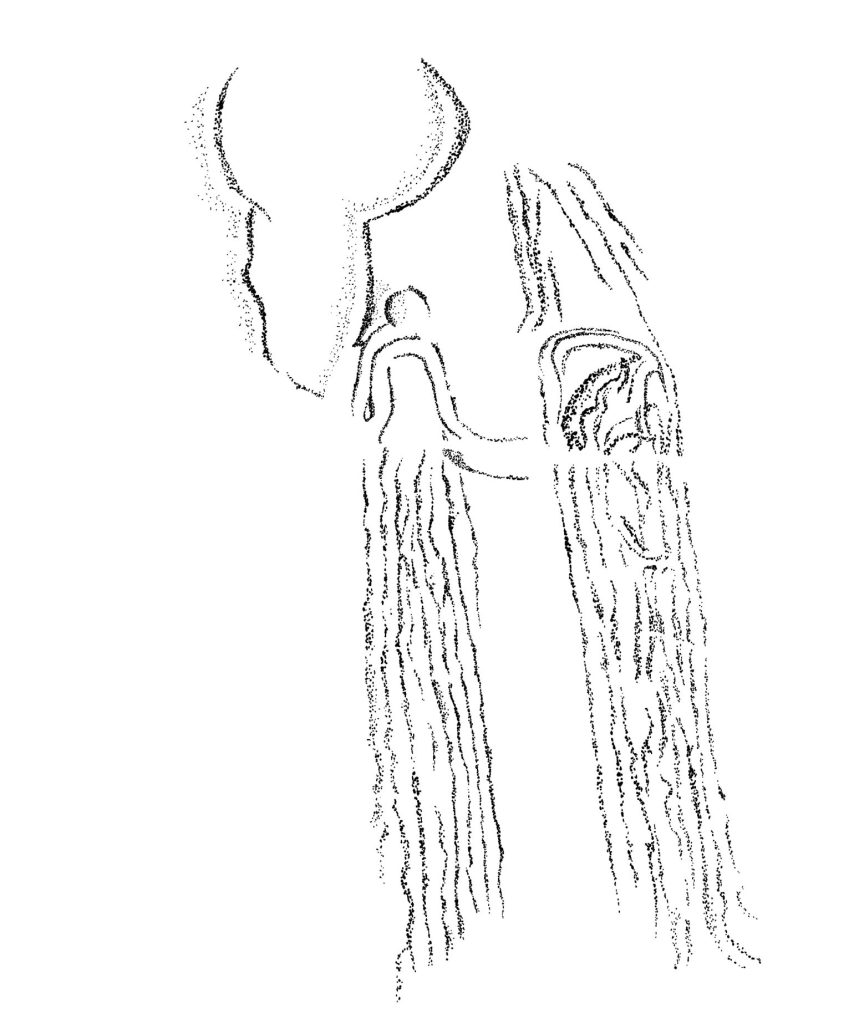
Figure 6 ©Shefa salem
In all rock art painted or engraved from a shamanic perspective, there is always a water hole. The shaman in Siberia enters a hole that serves as an entrance to the other world, as Mircea Eliade tells us. The Yakut shaman, to reach the other world, enters a hole left by inhabitants of subterranean regions. The Yakut shaman’s costume bore the symbol of a hole, which they called the “hole of spirits.” The shaman is accompanied by a water bird (the seagull), symbolizing the water of the Al-Qultah (Kettles). As Michael Harner states in his book The Way of the Shaman: “The shaman speaks of reaching the spirit world through a hole.” Al-Qultah (Kettles) is the threshold, the liminal zone between the spirit world and the material world. It represents the inner universe of secrets known only to the shaman. Some researchers speak of a journey to an upper world and a lower world. From our perspective, however, there is no lower world; the shaman’s journey is always to an upper world. After descending into the water hole and traversing the network that transforms into a narrow passage, the shaman finds himself compelled to choose and climb one of the threads of light that ascend to the water’s abode. We are speaking here of the shaman who ascends to bring rain. In (Figure 7), from an article by Woodhouse, we see this thread by which the shaman ascends to the upper world (note the shaman lying below, his spirit having ascended above). Michael Harner, in the same book, relates:
“A shaman from the !Kung Bushmen in the Kalahari Desert of Southern Africa recounted: ‘My friend, this is the nature of power. When the people sing, I dance. I enter the earth. I enter a place like the place where people drink, from a water hole. I travel a very long way, a very far way.'”
Al-Qultah (Kettles) is a sacred place; its water is the water of the divine. Rituals were only performed beside this sacred hole. One of the most important ways to understand the meaning and interpretation of rock art is to acknowledge that the natural world inspires the metaphors and symbols used in it. Al-Qultah (Kettles) is a symbol of mediation between the real world and the supernatural world. Shamanism is a complex dynamic developed to confront the drought that has been spreading for thousands of years. The rain shaman, when clouds approach, climbs a high rock, lifts his head towards the wind driving the clouds towards him, and stands motionless. Then he enters the water hole and goes to bring rain. His behavior closely resembles that of the lizard, which lives underground but emerges and stands motionless when it senses the coming of rain. It, too, lives in a hole, and when water fills it, the lizard emerges fearing drowning. Jeanette Deacon says of it: the lizard resembles the shaman in two ways: it appears dead but is not, and it knows when rain is about to fall.
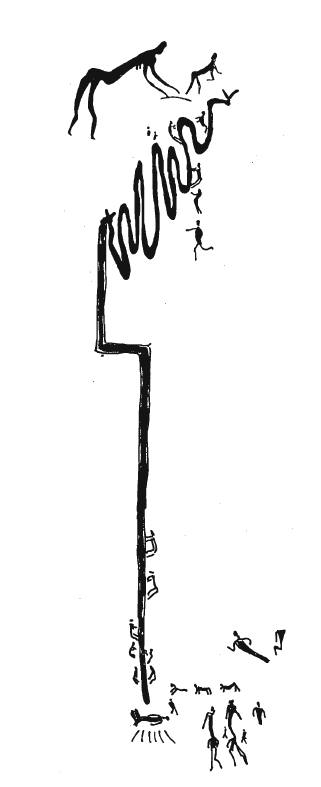
Figure 7 ©woodhouse
In an exceptionally dry landscape, Al-Qultah (Kettles) appears as a supernatural solution. What is also strange and exceptional is that Al-Qultah (Kettles) is presumed to be outside the shelter, collecting rainwater. Yet often we find Al-Qultah (Kettles) inside the shelter, close to the painted or engraved wall. For example, the Qultah (Kettles) at T-Anshal-t (Figure 8) is very close to the wall inside the shelter. Similarly, in (Figure 9) from Uan Muhuggiag, it is also near the wall inside the shelter. At In Farden (Figure 10), multiple Qultahs (Kettles) were carved directly beneath the shelter’s ceiling. This type of Al-Qultah (Kettles) is a sacred place that transports the shaman from one location to another. If access to the spirit world is achieved through the hole of Al-Qultah (Kettles), then the arrival of spirits into our world occurs through cracks in the walls. This coming and going necessitated that Al-Qultah (Kettles) be situated beside these wall cracks. Water seeps through these cracks and descends towards the Qultah (Kettles), which was usually carved directly beneath them. We typically find rock art murals surrounding these cracks. Drought made prehistoric humans expert in signs indicating the presence of water. They used the nature of the land, animals, ants, and other indicators to locate water. We must understand that the geography of water hole excavation and their locations was sacred. A water hole could not be excavated without performing the necessary rituals, preceded by a dream seen by the shaman relating to water.
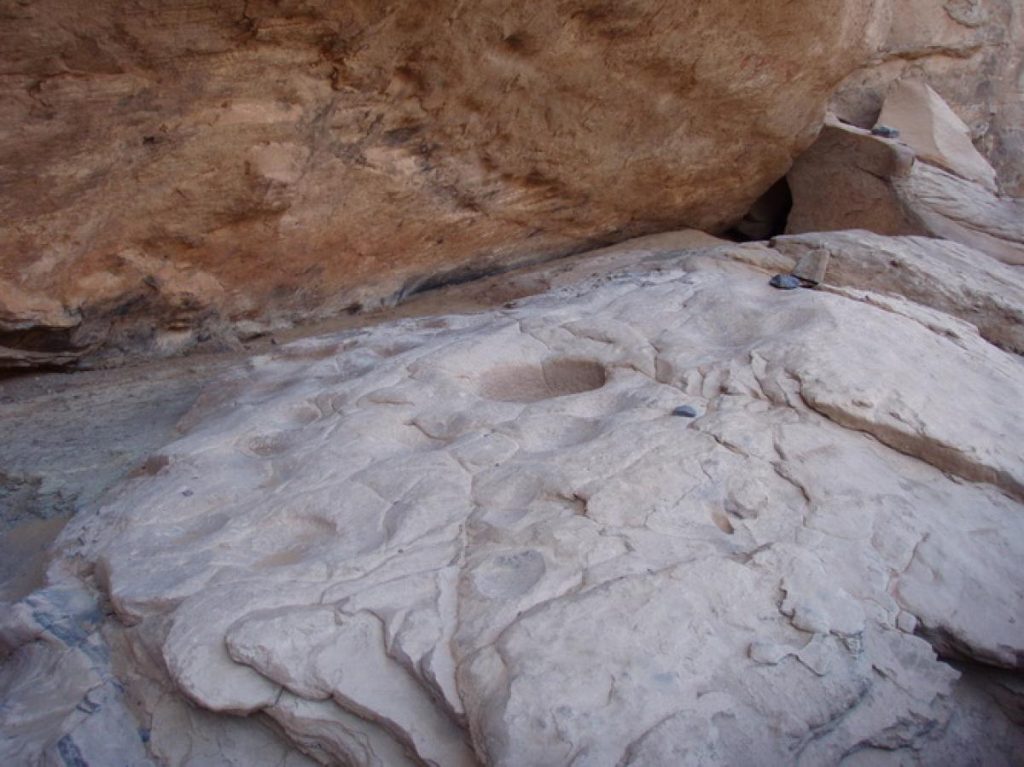
Figure 8 ©Jitka Soukopova
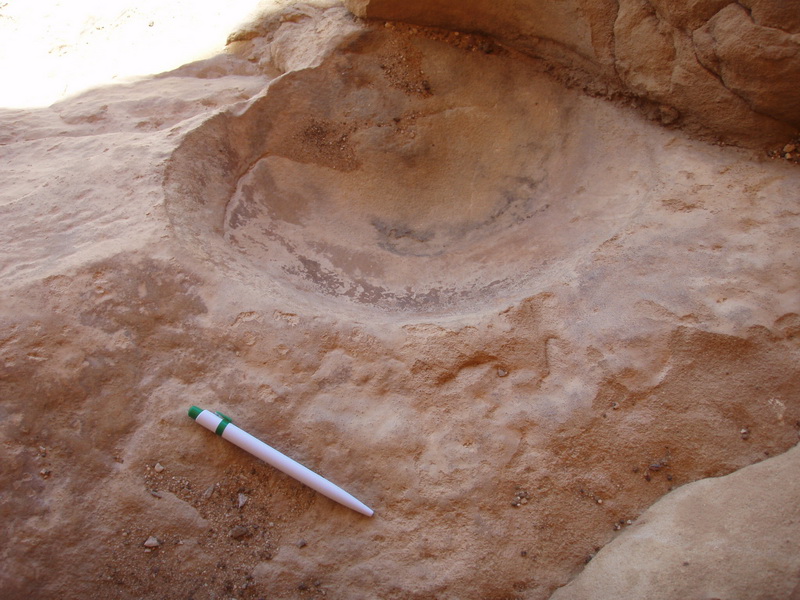
Figure 9 ©Jitka Soukopova
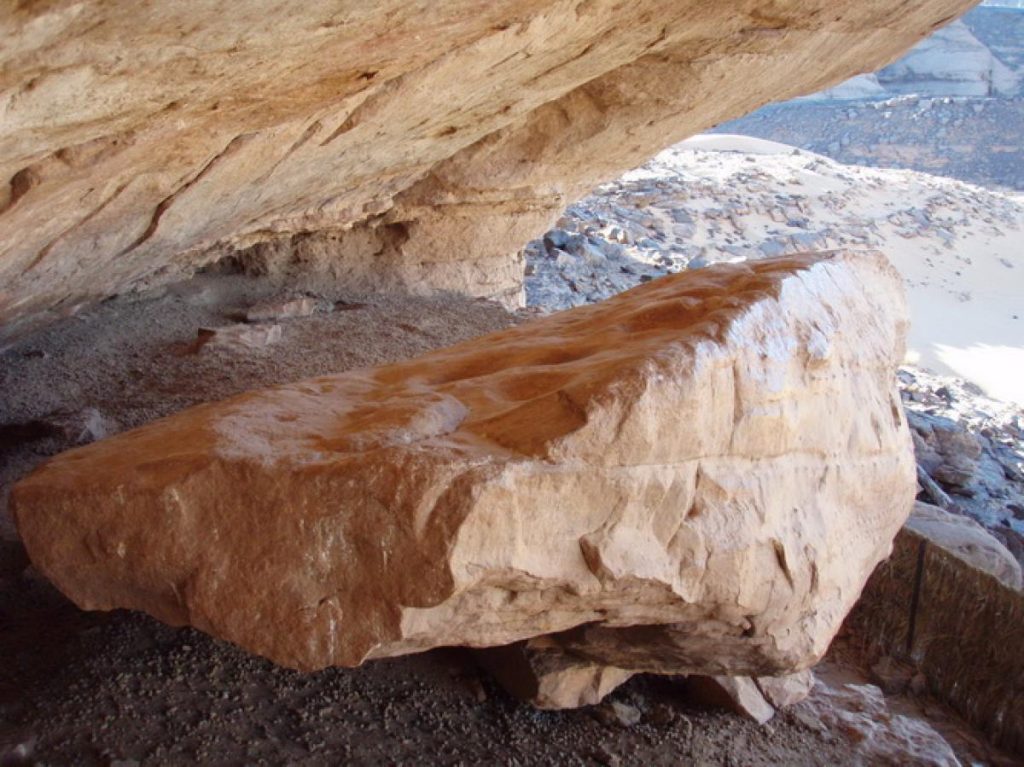
Figure 10 ©Jitka Soukopova
“For the San people of Southern Africa, one of the most important funerary practices was placing a perforated stone on the right thigh of the deceased male. One end of the tunnel-like hole contained a lump of resinous plant material used as an adhesive. Inside the hole, a continuous chain of fish vertebrae was found. The fish remains are interpreted as relating to the trance metaphor, where the shaman travels underwater, as the stone can be considered a metaphor for the water hole through which the shaman traveled to the spirit world.” This is from Lombard M. in an article titled: “Perforated Stones, Stone Rings, and the Concept of Holes in San Shamanism.” The stone in (Figure 11) was found buried beneath a grinding stone on Melora Hill. If we go to the Acacus, specifically to the Takarkori shelter discussed by Di Lernia and others in an article titled: “Colour in Context: Pigments and Other Coloured Remains from the Early-Mid Holocene Site of Takarkori (SW Libya)”, it is mentioned “that the site was used as a cemetery until 6400 BC.” Di Lernia and his team found a pair of perforated stones (Figure 12), but they were far from interpreting the reason for their burial in the shelter’s floor, or that the red ochre staining the stones and the remaining bone fragments in the burial was the colour of the supernatural.
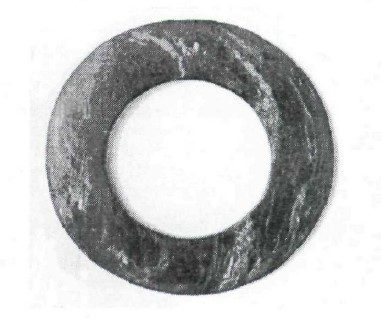
Figure 11 Fig.(Parrinder 1971)
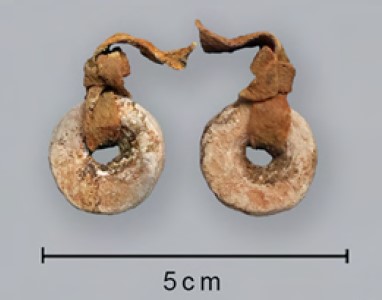
Figure 12 Photo by ©S. Giovannetti
Holes, cavities, and rock shelters were entrances to the spirit world. Carving them into the rock was an act of supplication for rain. Excavating a small hole into a rock on the ground or into a wall was a symbol synonymous with the shaman’s worldview. The shaman himself would carve these small holes into rocks and walls. Lombard M., in the previously cited article, states: “The hole… it is a sacred water hole. Right at the bottom, next to the water, there are two rows of small holes dug by the shaman Hisop.” These perforated walls are found throughout the Libyan desert. Here are some examples of their existence: (Figure 13) from In Farden – Acacus; (Figures 14 and 15) from Al-Messak. Note that these holes are always found near depictions of the rain animal. For example, (Figure 16) from the Acacus; (Figure 17) a rain bull from Al-Messak; (Figure 18) a rhinoceros, a rain animal, covered with such holes.
[^1]: *Al-Qultah* (Kettles) is a natural hollow or cavity in a mountain or rock where rainwater and runoff collect. The size of the *Qultah* (Kettles) and the duration water remains in it depend on the location and conditions. Water might persist in it throughout the year, even during the dry season, if fed by a source such as a spring.
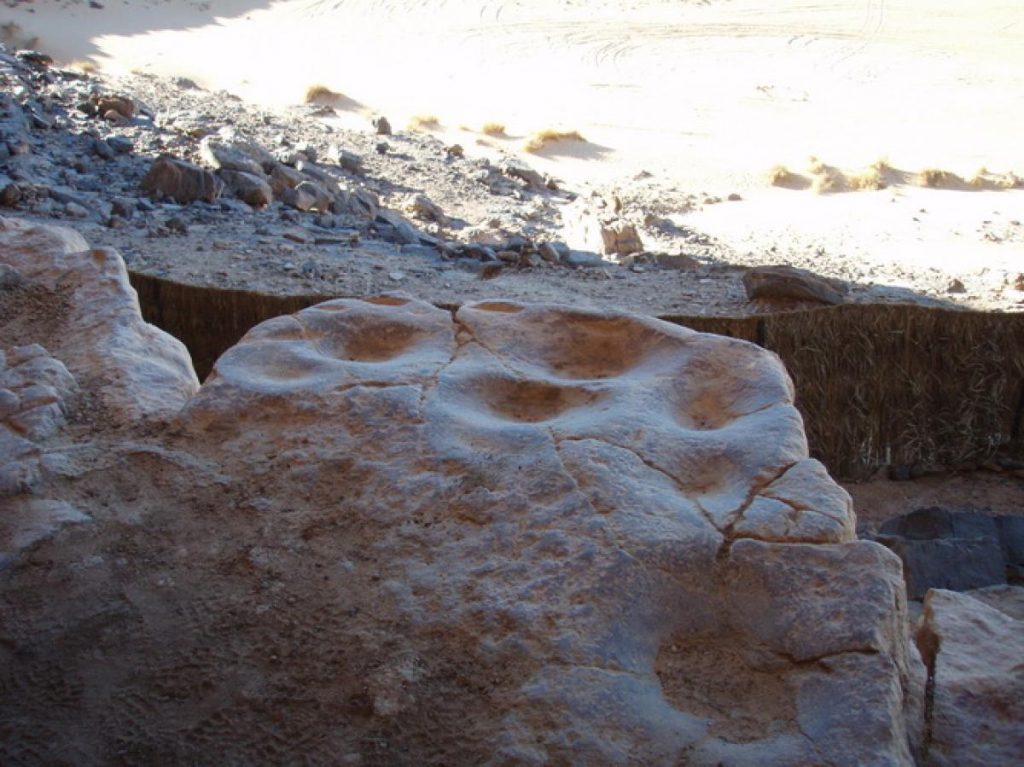
Figure 13
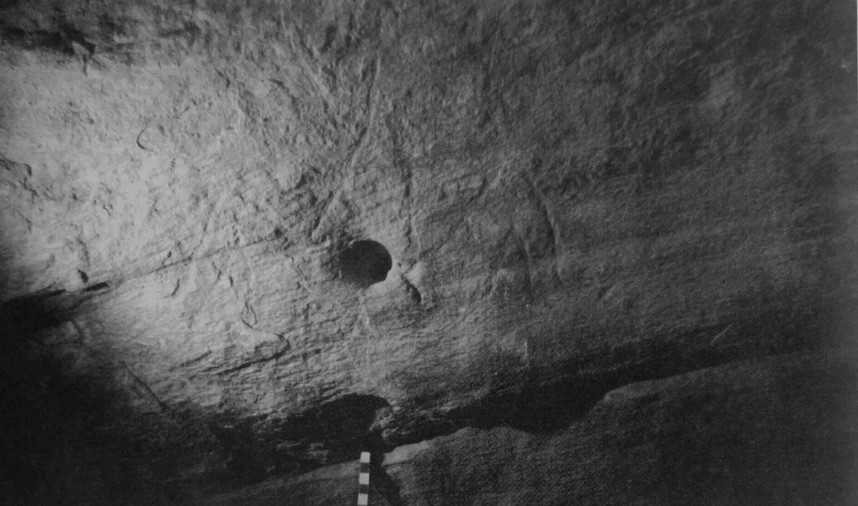
Figure 14 ©JEAN-LOÏC LE QUELLEC
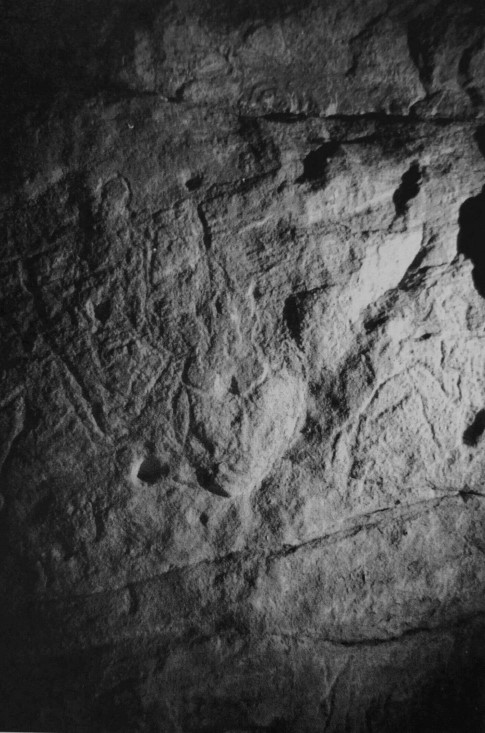
Figure 15 © LE QUELLEC
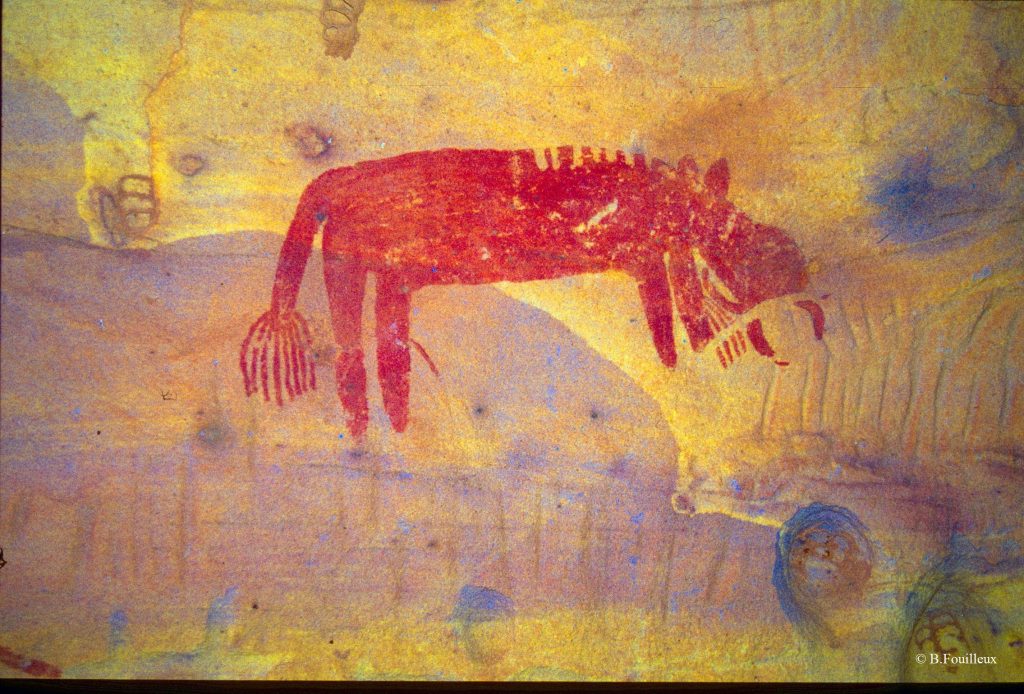
Figure 16 ©B.Fouilleux
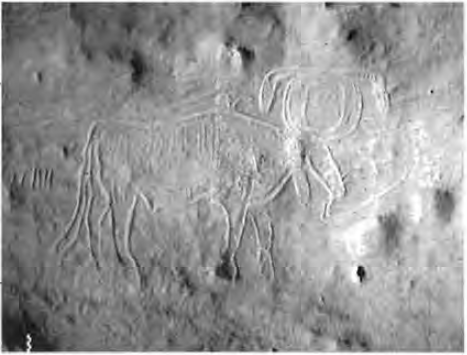
Figure 17 ©JEAN-LOÏC LE QUELLEC

Mohammed Abdallah AlThrhuni
writer and researcher
Share now: