The Myth of the Round-Heads Origin
Article: Shamanism, Mohammed Abdallah altrhuni
The Round-Heads are the most talked-about group in Saharan rock art, and no one knows precisely the extent of the excessive imagination associated with this group. Henri Lhote turned the Round-Heads group into a fog that covered the face of the world, and with his gentle voice, he presented a set of principal methods used by the Round-Heads in their murals. Henri Lhote was happy as he watched wonder plant its flags in the eyes of tender-hearted visitors. Muzzolini defined the Round-Heads based on a set of characteristics: The first characteristic “is paintings with outlines, often in ochre color. The second characteristic, the style varies according to the group, between simplification and realism, but simplification is not absolute, even among the ‘Martians’, and among the group we will call geometric, a certain flexibility in lines remains; the most appropriate is to use the term: semi-simplification. The third characteristic, the heads of the figures are often round or semi-round. The fourth characteristic, patina layers do not appear in these paintings, the bright colors that distinguish the Bovidian period and after.”[1]
Muzzolini added some decisive features such as that the animals are few in number and only appear with people, the weapon used is primarily the bow, and Muzzolini, like other archaeologists, does not forget the advice to act wisely and compare everything with Egyptian civilization, which did not exist at the time when those called the Round-Heads were narrating their stories on stones. If we want to know the origin of the Round-Heads, we must follow the footsteps of the air walking to Kel Essuf.
In an article titled: “Kel Essuf: A new facet of rock art in the central Sahara” written by Nadjib Ferhata, Karl Heinz Striedter, Michel Tauveron:
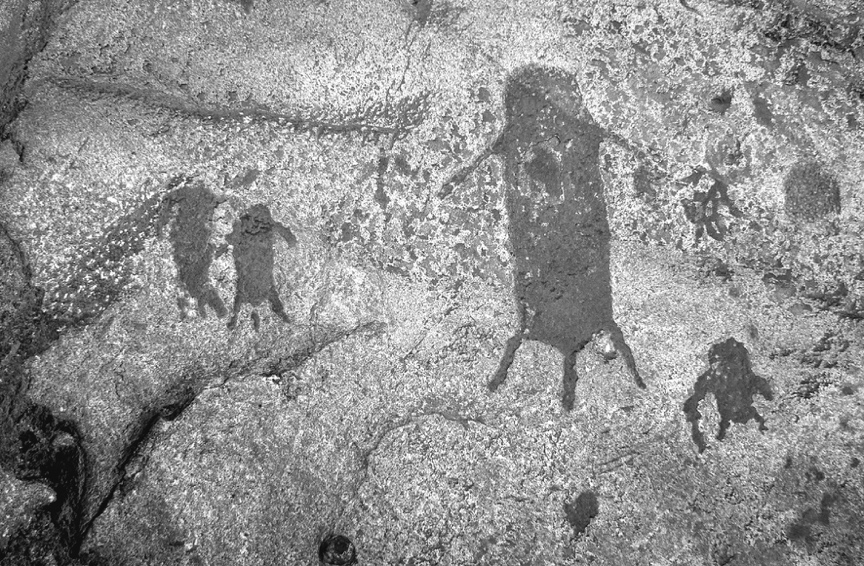
*“Recent field research in the Tadrart sandstone massif (extreme southeast Algeria), has proven the existence of a unique group of rock engravings we have named ‘Kel Essuf’ (Figure 1), and their characteristics are outlined below: We are dealing with a regional style as this type of engraving is confined to Tadrart (including some Libyan sites). Since Round-Heads period drawings cover Kel Essuf engravings, we propose that they are an ancient style, perhaps from the Pleistocene. Many drawings indicate no major breaks distinguishing the transition between Kel Essuf and the Round-Heads.”*[2]
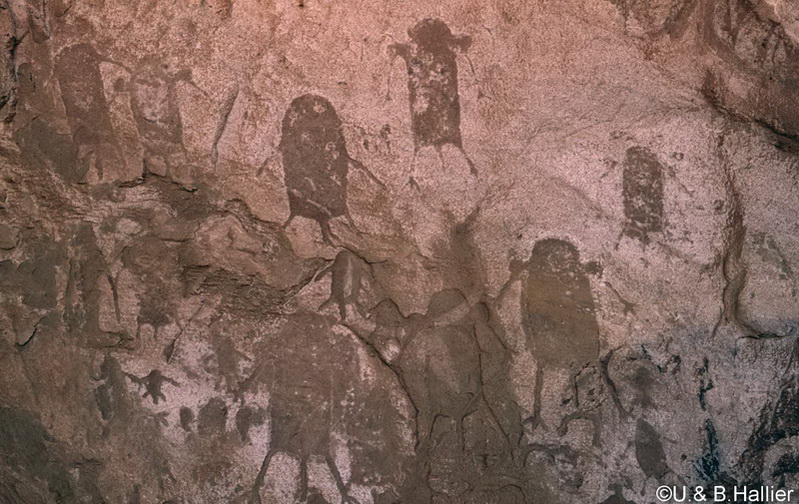
1-©U & B Hallier
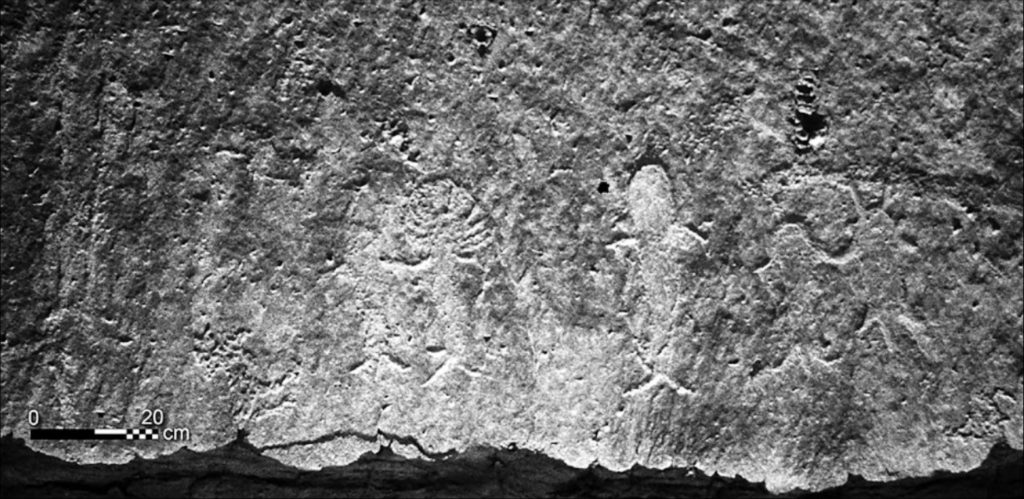
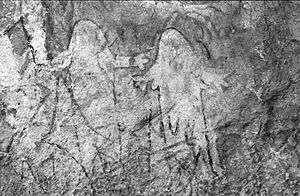
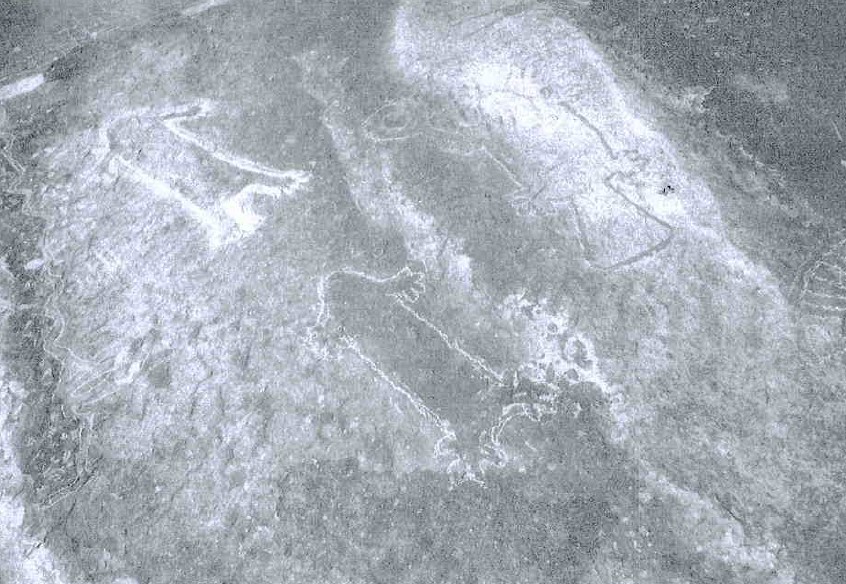
In another article titled: “Similarities between Round-Head paintings and Kel Essuf engravings”, researcher Jitka Soukopova says: *“So far, Kel Essuf engravings have only been found in Acacus (Figure 2), Algerian Tadrart (Figure 3) and Djado (Figure 4), but their spread may extend to a much wider area. These small-sized human-like forms, and rarely animal-like, have received little attention until recently. Mori first hypothesized their relation to the Round-Heads for Acacus, then Heller for Djado, and it appears that Striedter et al. have confirmed this relationship for Algerian Tadrart…. Mori’s hypothesis that Kel Essuf is a prototypical form from which Round-Head paintings evolved is supported.”*[3]. From all the above, we understand in a manner not devoid of fog and ambiguity that the ancestors of the Round-Heads are the small-sized human-like forms. Therefore, it can be said with words still warm, freshly emerged from the joint of rock art: whenever we find small-sized forms, we will, without excessive effort, find the trace of their evolution, which is the Round-Heads. And because these forms, present in the depths of immortality, are a regional subject not found in other areas, the matter turned into an irrational, magical biography of a tribe of lovers and devotees.
2- ©Jean-Loïc Le Quellec
3- © K. Striedter
4- ©U & B Hallier
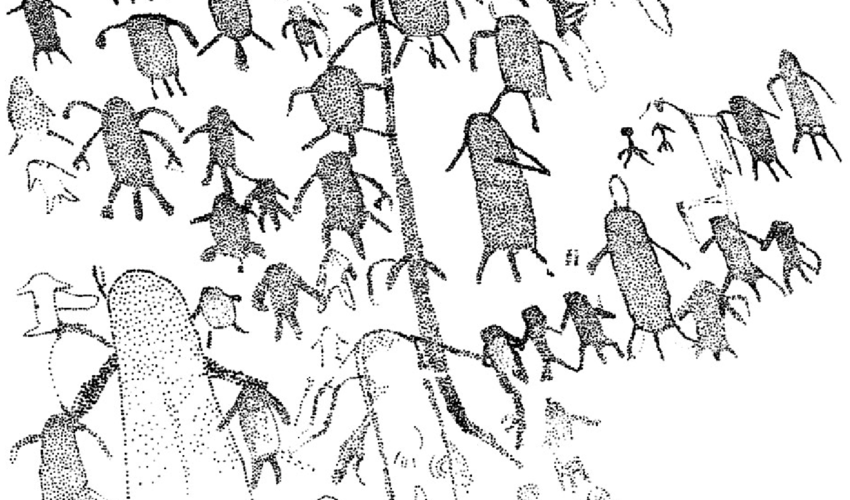
In a distant place resembling a vast question, and a land that hears only the loss of years, there is a rock art site in Yokuts known as “Uchiumgety Petroglyphs” in the Tule Indian Reservation – California. These engravings in America feed on time and love, and walk at night like a dense dream under Uchiumgety’s eyelids. In this engraving (Figure 5), there is a red beaver on the top right, and on the left a rattlesnake and a grey bear. The author of an article titled: “Shamanism, Natural Modeling, and the Rock Art of Far Western North American Hunter-Gatherers” ends by saying:
“Observe the visual patterns on the right side and top left, the centipede at the top, and the human forms in the center of the mural.”[4]. What are the small-sized forms doing in America? Does this mean there are Round-Heads in America? There are no Round-Heads in America, nor in Yokuts dreams. But there is shamanism in America and shamanism in the central Sahara, and this justifies the existence of small-sized forms in Acacus, Tassili, Djado, and the Tule River Indian Reservation of the First Nations, California (foothills of the Sierra Nevada). In the Yokuts language, the word “Bapdin”; is a geographical name for a place meaning “The Drowning Place”, meaning that in this place exist water spirits and the water hole from which the shaman begins his journey. Let us listen to David Whitley as he says:
“A Cahuilla shaman entered a water pool while on vision quests and saw the spirit of a frog, while it is said Imuklatata, a female spirit inhabiting a water pool near the Yokuts village, pulls swimmers and drowns them, i.e., takes them to the center of altered consciousness. It was also believed that supernatural spirits of many other kinds inhabited pools (qelta) and permanent springs. In fact, it was believed among the Numi people that the distribution of supernatural power followed the distribution of permanent water sources and high peaks, and this also explains the distribution of rock art sites.”[5].
5- ©David S. Whitley
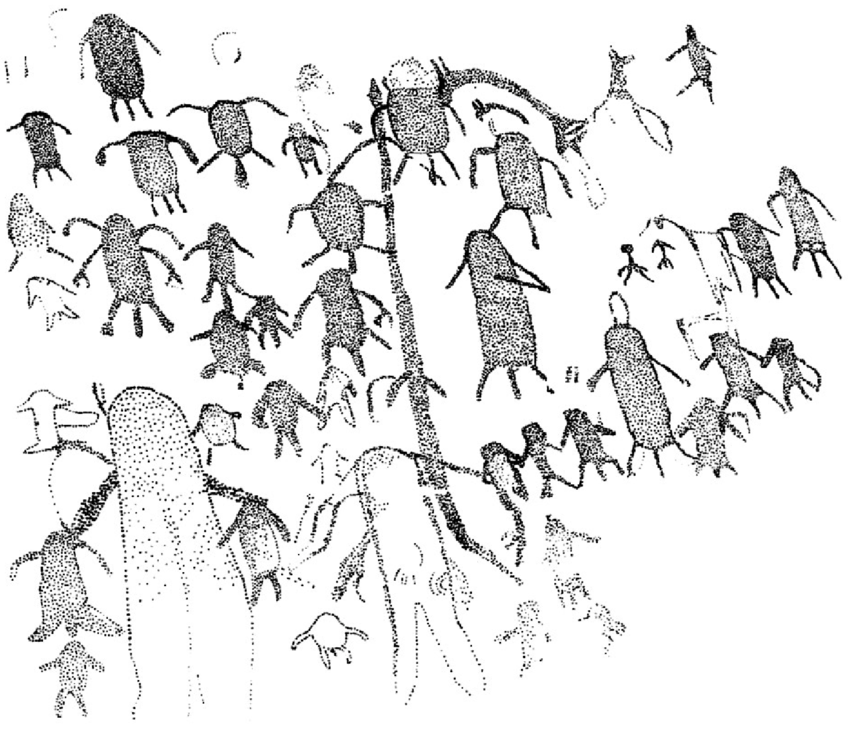
For the Tuareg, Kel Essuf means “Desert Spirits”, and means “People of the Void and beings of solitude, invisible beings”, and from our point of view are “Water spirits or pool and spring spirits”. This can be accepted if we look at (Figure 6) which no one has paid attention to before. In the center of the mural, there is a person ascending in a straight line from bottom to top, the Shaman. Around him are rain animals and beings dotted with raindrops. The head of the giraffe, a rain animal and an auxiliary animal in the shamanic perspective, is on the right, and the head of the shaman who ascended on his journey in search of rain is on the left. In the middle is one of the small-sized forms with an open head shaped like a water hole, from which water gushes upwards. These forms are water spirits in the water hole and in permanent springs. At the end of the Pleistocene, there was a long drought period, and these forms belong to that period, a shamanic period par excellence. The qelta or water hole was sacred, and these forms themselves, if we remove their limbs, we find they take the shape of a water hole. The whole issue is that the shamanic interpretation was not taken into consideration for approaching these small forms. And very curiously, there is a mural said to be associated with Kel Essuf, of a family of a couple and a child (Figure 7). There is also in Yokuts land the same mural of a couple and a child (Figure 8). There is no origin of the Round-Heads to search for among water and spring spirits. They are without a doubt from the desert inhabitants, and their ancestors are those who lived in the time of the great African animals. Shamanism in the central Sahara evolved due to drought and climate deterioration. The shaman and the rain animal had to play the role of savior in this tragedy. And perhaps the shamanism of the central Sahara is the highest that shamanic thought reached in all of Africa.
[1]: L’art rupestre prehistorique des massifs centraux sahariens-Alfred Muzzolini- Cambridge Monographs in African Archaeology 16 BAR International Series 318 · 1986- p 121-122.
[2]: Les « Kel Essuf » : un nouveau faciès de l’art rupestre du Sahara central- Nadjib Ferhata, Karl Heinz Striedterb, Michel Tauveronb- Académie des sciences-2000- p 577–580.
[3]: Similarity between Round-Head Paintings and Kel Essuf Engravings- Jitka Soukopova- Royal Academy for Overseas Sciences Brussels, 17-19 September, 2015 pp. 173-180.
[4]: SHAMANISM, NATURAL MODELING AND THE ROCK ART OF FAR WESTERN NORTH AMERICAN HUNTER-GATHERERS-David S. Whitley-Special Publication- Rock Art Foundation, Inc.: San Antonio, Texas — 1994- p 20-21.
[5]: ibid, 21.
6- ©
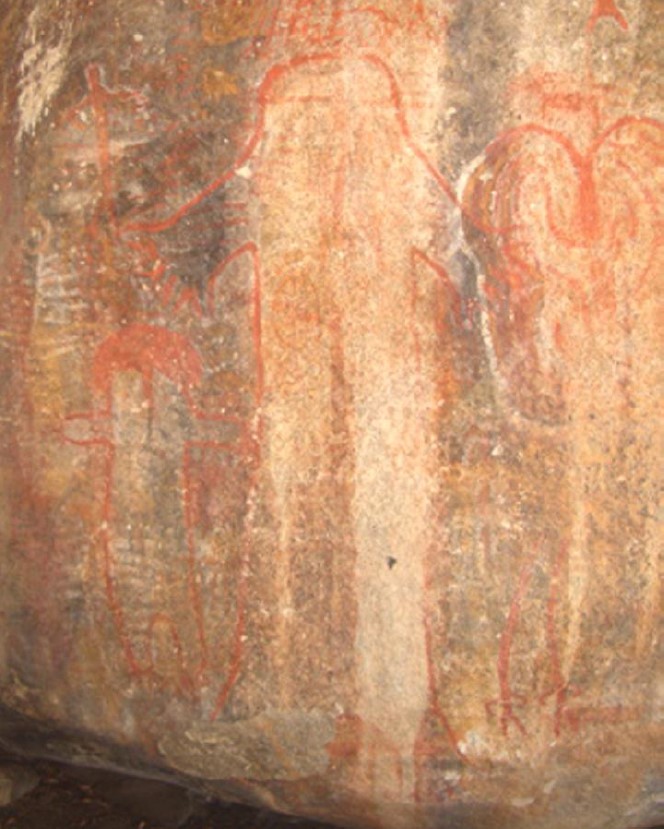
7- ©Kathy Moskowitz Strain
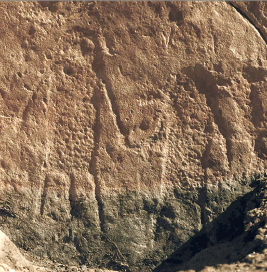
8-

Mohammed Abdallah AlThrhuni
writer and researcher
Share now: