
Basalt: The Poetics of the Ordinary Stone
Article: Geopoetic, Hamza alfallah.
In a harsh, dry space that gives silence the power of meaning, and like any contemplator while walking, a feeling of emptiness kept haunting me. I was looking at the dormant volcanic formations, as we were at an altitude of six hundred meters amidst scattered shelters, and among the black basalt stones that breathe from their lung the roughness of geological memory and the slow flow of time melted over an unforgiving surface. In that bitter experience, and after returning from the “Mastah”[1], I did not stop for a moment thinking about the basalt stone in order to write about it. And because I intensely desired to understand it, or rather to resist its harshness which I carried with me, I had to go to the lover Petrarch[2] to place this type of stone in the context of its characteristics.
In landscapes, the contemplator is not isolated from feeling the elements and their influence, for all the fine golden grains of sand are not as we see them in the presence of violent winds, and the gentle, charming wave before the shore will be no less fierce in the belly of the storm. Likewise, the narrowest and widest valleys, with their faces of tragedy and danger when attempting to explore their rocks lying dormant in the reefs and the scenic stones, and concerning the latter, Petrarch’s travels and his songs of love for Laura, in which he responds to the cosmic presence of the stone according to a graduated semantic system reflecting the transformation of the subjective emotional and existential experience, can tell us of an inexhaustible measure of misery, joy, and death resulting from sensing the skin of nature. And speaking of stones and Laura, who in Petrarch’s songs can transform into that living solidity, as clarified by a doctoral thesis in Italian Studies by researcher Celia Filippini titled: “Landscapes and Seasons: The Metaphorical Networks of Reality in Petrarch’s Book” Rerum Vulgarium Fragmenta, where in the chapter “Stones and Coral Reefs”[3] she points out this Petrarchan differentiation by negating Dante-esque harshness from the stone among the types pietra, sasso, scoglio, and their sensory connotations within the path of the poet’s emotional experience. The word pietra with its defined characteristics represents the stone of myth, the inevitability of deterministic solidity from which there is no escape, and it is the magic of the miracle as a metaphysical idea, often linked to classical references. Under it fall words representing specific stones with the trait of aesthetic coldness like marmo, diamante, and diaspro which embody ritualism and dead purity, and are directly connected to the weight and petrification of Medusa. As for sasso, it is the stone of uncivilized primitiveness, the matter of existence and psychological hardening with which the (Self) identifies with difficult stoppage and rigidity. And when this stone acquires its topographic dimension, it becomes sasso-lieu, a mediator between nature and as a witness in the place, where waters spring and places form. In contrast, scoglio expresses the stone of tragedy, an obstinate stone that exists only within a path and movement, and embodies the stumbling of the emotional poet, from a potential threat to the shipwreck and loss of direction.
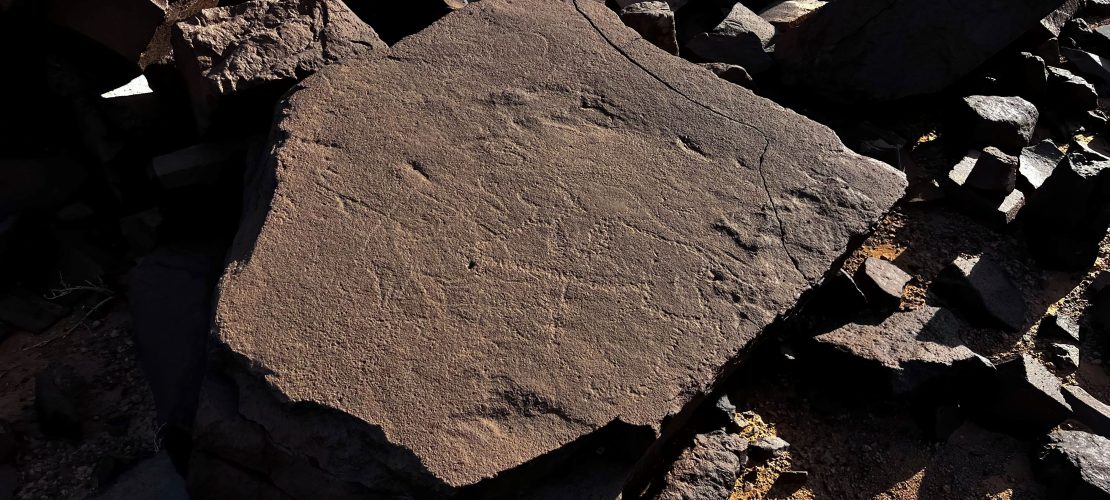
Within this emotional gradation in the voice of the troubled lover, we can deal with the basalt stone as an extreme form of sasso: a rather ordinary stone: dark, extremely harsh, and physically exhausting. It does not carry the ultimate clarity of myth nor the catastrophe of the nautical event, but clearly embodies the harshness of the path and the existential confusion itself, where solidity is tested through the body and walking, not through sight or transformation. At the same time, it gains a topographic dimension in the region of the Black Mountains, especially in the vast expanse of the “Mastah”, which is the area lying in our direction from the ascent path from the elevated branch in Wadi Al-Sart, between Wadi Tifdist on the right where the large “Mastah” extending for several kilometers until the end of its edges to the beginnings of the Fazzan branch and Wadi Taskouh on the far left. Basalt is the ordinary daily stone, the familiar stone that suffers from its savage density, and from its excessive failure to transcend its poverty to become precious, despite its sweeping prevalence in the natural landscape. And why would this type become precious anyway? It is the rugged road stone—the stone of practicing futility, stripped of its sacred mythical aura and magic. Undoubtedly, the slow walking, the intrusion into its space, was more hostile even than the feeling of terror when entering at night into a vast human cemetery teeming with bones and skulls.
This gave me, as I contemplated for a long time the photographs of that field experience, an opportunity to think that there are environments that by their nature reject any intruder and do not easily grant forgiveness for wandering in them—exceptional and cunning environments because of the feeling of pain upon discovering them. Between physical collapse and walking on an irregular surface, this stone, when dealt with, loses its literary function, and the writer-explorer is emotionally defeated before it, due to his inability, while walking for long miles in this kind of vast and remote land, to grasp the illusion of the dreamy possibility of seizing the poetics of the soft moment. Thus, the text becomes closer to a fierce writing of the erosion of the self, a violent text not written with words, but wrestling with the eternal ash of time.
At that point, we were not all well nor feeling anything in the space of basalt, at the peak of psychological breakdown, as we slowed down and tested the appropriate place to put our feet to cross in the most formidable remote places. Our guide, Dr. Mahmoud Abdel Mawla, was far ahead of us, searching for a nearby and safe branch to descend, to escape the feeling of pain, and we continued to chew the plant (Al-Maknan) to combat thirst after the water we had ran out. The most truthful thing that can be said about this stone is its direct connection to pain, and the testing of the weak and sickly emotion resulting from strict wandering. It is not a stone for any kind of psychological transformations, but a stone for harsh immediacy and anxious caution—a stone for sharp attention, due to the hardening of the state of prolonged suffering while walking on its surface, to reach the end of the battle. It is lived physically, and this is what I felt from the absence of emotion in its space, and from a layered time difficult to imagine that it carried. On the journey, it is not necessary for the writer-explorer to be a poet, and if he happens to be one, he is bound by his commitment, through language and feeling, to pull the thin thread of connection in the heart of the natural world, and the muscular and psychological challenges that imposes on him, as he is immersed in the details of the experience. So the feeling of fear that used to seize us from the basalt stone is our absolute refusal to lose the shadow image that this type presents, despite its harshness. And this is perhaps what I was wondering about before entering the land of writing, in order to summon all that hardship and fragmentation I experienced, and I found the answer simpler than it should be: that there is absolutely no possibility, with this stone, of finding the smooth flow of an idea amidst the hardness of scattering in this deadly horizon.
On the edge of the branch, after finally catching up with the guide, I remember well the end of the trek for descent and leaving the “Mastah”. Al-Tarhuni looked back contemplatively at all that distance covered with a bit of impatience, took off his straw hat, drying the sweat from his forehead, and we sat to catch our breath; no water available, nor were the remnants of the Al-Maknan plant in our bags able to help us at that moment. The scorching sun was bearing down on our necks like a sharp and shiny blade, watching our refusal mixed with a temporary emotion for the primitive form of the terrain and the place as a whole, leaving behind us all the Garamantian graves that contain the final silence of memory, and the reality’s refusal to add anything to the history of the dead, and because I was congested then like a repository for complaining of pain, I sat long after the end of the journey to write a text while carrying with me this bad feeling and something of blocked desire, in recovering the original relationship with the topography of the great “Mastah” and the unpleasing harshness of basalt, and I do not know exactly whether this text is about the harshness of climate and stone or a tale about the paralysis of the shaman’s spirit in periods of drought and the loss of ancient nature’s wet heart, so I cannot in any case think only of the husks of this anger when remembering the basalt stone, but of the final moments I can borrow, not for their mythical quality, but for their dark savagery, embodied in that staring gaze of Medusa’s grief over the extinguishing of maternal time and fertility when her head was cut off by Perseus’s sword, and I, at the writing table, sucked the taste of the salty sweat of betrayal in my mouth.
[1]: Al-Mastah : A colloquial term expressing a large extended area of basalt stones, containing a large group of shelters, circular graves, and old paths for caravan routes.]
[2]: Petrarch] (1304–1374): [Italian poet and philosopher, author of] *Rerum Vulgarium Fragmenta*[, used natural images and stones to explore the emotional and existential experience of the poetic self.]
[3]: Célia Filippini, *Landscapes and Seasons: The Metaphorical Networks of Reality in Petrarch’s Rerum Vulgarium Fragmenta*, doctoral thesis, Université Sorbonne Nouvelle – Paris 3, December 12, 2015, supervised by Anna Fontes-Baratto, EA 3979 – Les cultures de l’Europe Méditerranéenne Occidentale (LECEMO), chap. IV, “Stones and Reefs”, pp. 69–77.

Hamza alfallah
writer and researcher
Share now: