A Stroll Through the Spiritual Landscape of Archaeology
Article: Archaeopoetic, Mohammed Abdallah altrhuni
“Do not forget: no progress can be achieved in archaeology by merely assembling discoveries.”
The Dilemma of the Artifact
“In 2006, driven by growing dissatisfaction with the state of archaeological theory, despite its importance in university archaeology departments across many Western European countries, we joined forces to organize a provocative session during the 12th Annual Meeting of the European Association of Archaeologists in Kraków. Just as Roland Barthes had done some forty years earlier when he challenged the traditional, ignorant orientation by proposing ‘the death of the author,’ questioning whether the author’s existence and intentions hindered our critical confrontation with the literary text, we decided to propose a session titled: ‘The Death of Archaeological Theory’ to stimulate radical questions about its future development. We wondered whether the study of past societies through their material culture—i.e., archaeology—would greatly benefit from somewhat neglecting traditional theory and ideology, theory and ideology which had begun to hinder our pathways to reconstructing the past over the preceding twenty-five years. Would archaeology be better off ignoring unified theoretical models in favor of a freer application of methodologies appropriate to our real goals, which many see as creating a truthful reconstruction of what happened, why, and how life was, insofar as we can achieve it using modern techniques? Thus, we wondered if ‘the death of the archaeological theorist’ might be a liberating intellectual experience.”1
Prehistoric archaeology, until the late 1950s, was like a pale blue screen flickering in a way reminiscent of despair, and no one in academia spoke of it without that comical tone. It might have turned into damp, moldy papers had it not been for the emergence of Processual Archaeology in the early 1960s. It is one of the traditions of thought that appeared to overcome the pessimism of final archaeology. The most important aspect of Processual Archaeology is the study of the archaeological record in itself, not merely as a substitute for a previous cultural system. However, Processual Archaeology faced a challenge in the early 1980s due to the emergence of Post-Processual Archaeology, and it became clear over time that this post-processual science was not spared the bruises of excessive political passion. Archaeology had a general feeling of being unable to avoid the labyrinth and that it was an empty space not devoid of clamor. Afterwards, scientific Post-Processual Archaeology attempted to reverse the course of archaeology by calling for interpretation and a historical approach to prehistory. There were many contradictory theories about archaeology, to the point that many felt doubt in archaeology’s ability to provide definitive narratives about the past.
One of archaeology’s biggest problems lies in its increasing absorption of ideology and growing anxiety towards issues like heritage management, indigenous archaeology, and the repatriation of artifacts and human remains, in addition to all the aforementioned. While archaeology was trying to mature, grow, and search for new working tools, postmodernism emerged, celebrating diversity, plurality, fragmentation, and indeterminacy. Its appearance not only disrupted the attempt to seek coherence and order in archaeology alone, but all humanities were confounded because postmodernism is not a coherent intellectual system that is easy to define. However, the most important characteristic of the postmodern intellectual system is skepticism towards positivist science and the word “truth.”
The postmodern intellectual system may not be coherent from some viewpoints, but what it celebrates—diversity, plurality, fragmentation, and indeterminacy—was clearly evident in the texts of its thinkers. The writing style of these thinkers was interdisciplinary and playful, as much as it was provocative. The real challenge that came to face archaeology was transforming the vast amount of data it possesses into knowledge, and into an interdisciplinary text that presents knowledge and possesses social meaning. In all humanities departments in Europe and America, many academics have become interdisciplinary, cross-disciplinary, or non-specialized. The disintegration of disciplines has given the humanities new importance as researchers move from their known spaces to new, shared fields. However, archaeological thought has not liberated itself from absolute commitment to doctrines and old viewpoints; change within it has been very slow. This is perhaps because archaeology stopped at a crossroads between science and the humanities, feeling horror at transforming into an interdisciplinary subject where the humanistic element would dominate. Archaeology fell into the trap of dreaming of scientificity, due to its early influence from geology and biology. In the mid-twentieth century, with the advent of radiocarbon dating, the dream of scientificity expanded, and finally, archaeology lived the ecstasy of dreaming with the emergence of genetics. It must be noted that this part of archaeology is exclusive to countries and institutions with high economic capacity, capable of building high-quality laboratories and training their staff to use advanced equipment. But these borrowings from the natural sciences did not guarantee that archaeology itself would be a science. This pilot dream of scientificity had taken archaeology far from being the profession children dream of practicing one day. This dream was replaced by the saying of Kujala: “No real archaeology without imaginative elements, no archaeology without the fantasy of time travel.”2 The artifact lost the momentum it had enjoyed after the emergence of new ideas for interpreting the past and its remains. Time travel is not a joke or mere myth to be talked about. Time travel is the virtual simulation that allows us a direct encounter with the past without the need for preserved fragments from ancient times.
In the era of the third scientific revolution, represented by data integration and analysis through methods derived from different disciplines, archaeology entered the field of interdisciplinarity through the narrow door after confirming that the natural sciences have the upper hand. In fact, interdisciplinarity in archaeology became mired in theoretical issues, and this often led to the marginalization of the humanities. Archaeology wanted to be precise, deterministic, and independent of any subjectivity during scientific observation. It wanted to distance itself from the less precise, more ambiguous humanities, which are always susceptible to interpretation. Archaeology searches for the artifact it finds by chance in an exceptional dramatic moment, but this moment turns into a material piece, a set of data, something left behind by past human societies. Archaeology ignored the human factor and focused on the material piece, and on describing it, not explaining the reason for its existence. This is the reason for the emergence of Post-Processual Archaeology, which asserted that objectivity cannot be attained in archaeology, and cemented archaeology’s belonging to the humanities, which focus on ideas, meanings, symbols, details, and relativity in understanding the past. Archaeologists’ disregard for their own assumptions led to the killing of the spirit of this science. And because studies of material culture in themselves did not develop, we lost the knowledge of how to live archaeology, because the goal of archaeology should be developing self-knowledge, knowledge of the present, knowledge that becomes a factor for social action and a catalyst for critical self-awareness. The archaeology we should live is the one that makes the artifact part of a comprehensive narrative answering the question: how was life in the past.
The Dilemma of the Archaeological Text
What most concerned archaeology in postmodernism was: those texts that celebrate diversity, plurality, fragmentation, and indeterminacy, and that these texts focus on the multiplicity of meanings within past societies, also that cultures are a heterogeneous set of overlapping and conflicting interpretations. These ideas do not suit their inclination and their confinement of their material into patterns, systems, and structures. Archaeology found itself in a dilemma between the two concepts of the artifact and the text. In archaeology, the artifact is the essence of any study, but this piece does not transform into a historical source by pushing it into the interdisciplinary space; rather, it remains fixed in its place, and with it, all of archaeology. Only the text is capable of accomplishing this task by taking the artifact with it beyond the boundaries of archaeological discourse. Archaeology fears this text because it does not require arguments to be linear or sequential, but they must fit comprehensively into an overall pattern of coherent threads. The classic academic text in the field of archaeology stood in the way of the progress of this science. In Europe, scientific writing in the classical manner is only for obtaining a stable position at the university. In Arab countries, Master’s and PhD theses are turned into books in archaeology, which explains why students of this science themselves feel resentment towards strict scientific discourse. In the mid-twentieth century, the usefulness of established forms of archaeological writing was questioned. Perhaps the greatest amount of experimentation in academic archaeological literature appeared in the publications of the eighties and nineties, during which postmodernism had a significant influence on anthropology. This influence can be reviewed particularly in North America, where archaeology is generally viewed as a branch of anthropology.
In 1997, a conference was held titled: “Archaeologists as Storytellers” This conference sent a message that it is possible to write archaeological research results in an engaging way, and that there is a wide scope for archaeologists to change their style. One of the most important results of this conference is that technical writing never served archaeology in any way, and that liberation from positivism had given archaeologists an opportunity to follow an interpretive approach that does not require them to answer the big questions. This conference also drew attention to the emotional value of the archaeologist’s material, and neglecting this value contributed significantly to their writings not reaching the general public. Michael Shanks says in the Cambridge Companion to Imagination:
“Archaeological imagination is a creative capacity used when we experience the traces and remains of the past, when we collect, classify, preserve, and restore, when we deal with these remains, collections, and archives to present narratives, reconstructions, interpretations, or anything else. Archaeological imagination involves a special sensitivity and emotional harmony with a dynamic interaction between the presence of the past in the remains and its absence… Archaeological imagination, as a speculative capacity, or a capacity to assemble remains into meaningful forms, is an essential element in our experiences with the past.”3
Archaeological imagination may constitute a kind of dramatic art. The archaeologist works like a writer, choreographer, or theater director, when it comes to organizing the motives, behaviors, and actions of fictional individuals. Reconstructing the past requires the writer’s style and the dramatist’s imagination to recreate an imaginary image of what existed at an archaeological site. Thinking in this way takes the archaeological text into the context of understanding and supporting the audience. There is enthusiasm among people to read a novel about prehistory and fascination with cinematic films depicting prehistoric life. These novels and films exploit the gap of the weak evidence base for prehistory, but they offer a convincing fictional narrative for the viewer, something any archaeological report fails to do because narrative has no place in it.
In an article titled “The Archaeologist as Writer” Jonathan T. Thomas says: “For researchers working in the humanities and sciences, an explicit focus on the rhetorical aspect of their writings may be viewed with suspicion. Saying that I am truly focusing on making my paper well-written and interesting, or that I am dealing with different types of historical narratives, is easily misunderstood as not being methodological or, worse, as unscientific.”4 Those who do not feel this problem are the ones who produce archaeological texts for their personal consumption or for their students to read without hearing their comments about them. This orientation is inherited generation after generation. As for the scientific writing they talk about, it is laden with terminology that has no meaning for the reading public. Using technical scientific writing as a means to establish credibility has become an embarrassing matter today. The archaeologist living in our era will have visions about their archaeological site but cannot fully justify them based on data. The archaeologist considers these visions too personal and does not write them in the report because they are not science. This magical and emotionally rich aspect of archaeology does not exist in the archaeological text in our countries. Everything personal and reflective must be expelled from this text under the pretext of scientificity. We must not be drawn to the sad pleasure that the artifact arouses in us. There is no room for expressing the inspiring sadness we feel while working at the archaeological site. There is no mention in our archaeological texts of the site as an intimate place where we experience our human memory. Returning again and again to the site, we begin to feel familiarity; over time, the site transforms from a physical space into a meaningful place. The archaeological text fears that this poeticism will seep into its text and it will lose its scientific attribute.
The Concept of Archaeo-Poetics
In our book “The Land of the Garamantes,” we introduced the concept of Archaeo-Poetics as a rejection of the positivist claim of superiority and the differentiation between disciplines. Here, we will attempt to expand the concept by discussing the Archaeo-Poetic text. In the absence of this text, there will be other representations through which people will understand archaeology. Cornelius Holtorf, in his book Archaeology is a Brand, sees that the most important source of information about archaeology is television, focusing specifically on series in Germany, Sweden, and the United Kingdom. Holtorf also shed light on another issue: the representation of archaeologists in popular culture. “Archaeology has become a symbol for an exploratory journey involving travel to exotic sites, simple living and working conditions in the field, unexpected tests and dangers, followed by amazing discoveries, treasure recovery, and the virtuous hero’s successful return home.”5 This adventurer appeared on cinema screens in films like Indiana Jones, Lara Croft, and others, and in literature, this character often appeared in Agatha Christie’s novels—wearing high boots and a hat, roaming the horizons in search of antiquities. Surveys confirmed that the primary source of information about archaeology is television, followed by travel, museums, films, and newspapers, with archaeological books coming last on the list. If this is what happens in Europe, what is the case in a country like Libya?
This dominance of television, cinema, and newspapers clearly indicates that archaeology is incapable of writing engaging texts, while novels that present alternative archaeology are the best-selling in the world. The situation is that these novels have no fear of metaphor, mood, and simile, whereas the traditional archaeology text feels horror towards these dangerous words. Metaphor is a practice in which the narrative imagination constantly refers to another pattern of ideas and events. It is a representation that explains itself, and in the broad sense, it means that every story has a tendency to generate another story. As for allegory, it emphasizes that every realistic image, as convincing and rich as it may be, is in fact an extended metaphor, patterns of associations that point to additional coherent meanings—allegory reminds us of the great power of interpretation.
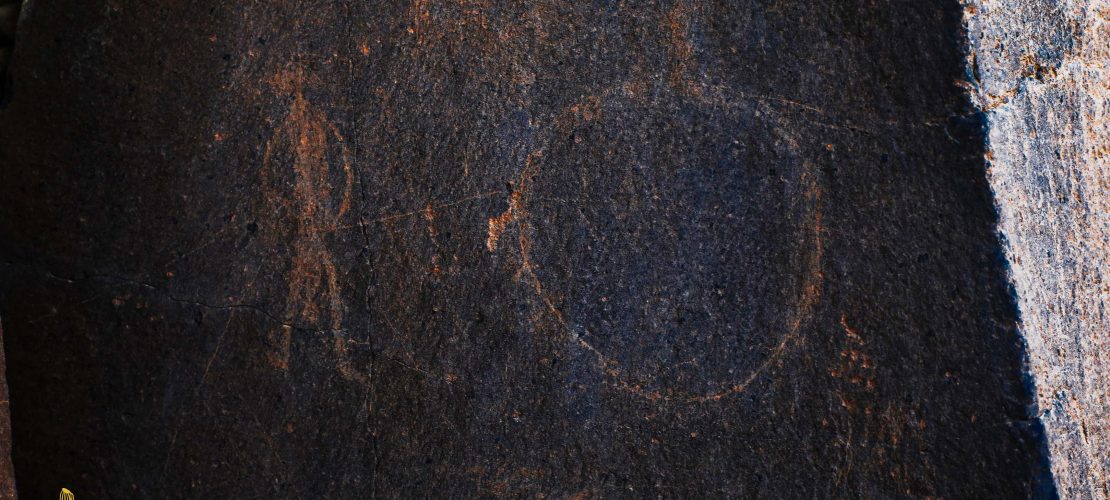
Rock art has posed a problem for archaeological records and how these records interpret the past. This is due to rock art being art that needs interpretation and explanation like any other art. Archaeology neglected symbolic and non-utilitarian behavior under the pretext of the inability to record it quantitatively. Some said that rock art panels are merely decoration adorning cave or shelter walls; others looked at rock art as a record of important and unimportant events, going so far as to say that they are portraits and humorous caricatures. Had it not been for the intervention of ethnography and symbolic anthropology, concerned with the multiplicity of meaning, the matter would have remained as it was until today. Perhaps rock art can be neglected in the West because this art is rare, but in a country like Libya, where rock art constitutes more than eighty percent of its antiquities, the issue cannot simply be ignored. In the last ten years, archaeological research has realized that rock art is more important than the traditional artifacts that archaeology is concerned with. Rock art murals provide the oldest essential information for understanding human evolution at various levels of knowledge. Rock art is the greatest tangible evidence of humans’ ability to think about things outside the circle of meeting physiological needs because it tells us how our ancestors thought about themselves and the world around them. Rock art consists of texts that transmit ideas, beliefs, knowledge, and traditions. For our ancestors, rock art was not an end, but a temporal portal through which they send us messages that constitute historical testimony about their lives and development. It is the first step towards writing and complex cognitive action. Much rock art is, in fact, metaphors, and to write about these metaphors, one must use metaphor, mood, and simile in an attempt to create a text that mimics the engravings. Archaeo-Poetics is the integration and interaction with texts written thousands of years ago. For the Archaeo-Poetic text, all of the past is present within it, but it says it in another tone and with a passion more attractive than the embalmed texts that hate pure pleasure.
[1] The Death of Archaeological Theory?- edited by John Bintliff and Mark Pearce – Oxbow Books 2011.
[2] The Archaeology of Time Travel. Experiencing the past in the 21st Century- Petersson, Bodil y Holtorf, Cornelius Eds- 2017 – p 297
[3] The Cambridge Handbook of the Imagination- Edited by Anna Abraham-Cambridge University Press- 2020- p 47-61.
[4] Subjects and Narratives in Archaeology- edited by Ruth M. Van Dyke and Reinhard Bernbeck- UNIVERSITY PRESS OF COLORADO- 2015- p 169-187.
[5] ARCHAEOLOGY IS A BRAND- Cornelius Holtorf- Routledge- 2016- p 63-64

Mohammed Abdallah AlThrhuni
writer and researcher
Share now: