
Children of the Water
Article: Shamanism, Mohammed Abdallah altrhuni
In the southern Sierra Nevada region of the United States, a statement from an informant of the Western Mono tribe explained: “The healers, bohag… would draw their souls (anet) on the rocks to show themselves, to allow people to see what they had done. Among the Cosho Shoshone tribe and other groups, rock art was attributed to the ‘Children of the Water’, and among the neighboring Tübatulabal tribe, the Children of the Water themselves were identified as the painters.”1
The shaman is a child of the water. Shamanic power comes unbidden; a person is born a shaman. When born, they know they will become one. In another article titled “Shamans, Gates, and Children of the Water: Southern Paiute and Landscape Affordances in Southern Nevada,” the authors state: “Delamar Valley is a unique place within the Southern Paiute territory, where volcanic hills containing many Children of the Water, mountain sheep, and shamanic pecking marks function as gates to another dimension. These gates form a spiritual channel through which the shaman can pass from this current physical dimension to an inverted one, and in this dimension, the shaman transforms physically and spiritually.“2
The shaman is linked to bringing rain, which is the task the community expects them to perform. Bringing rain after rivers and springs have dried up became the shaman’s most important work. The shaman’s task in the murals of the San people of South Africa is to bring this rain. To accomplish this mission, the shaman enters an altered state of consciousness. This state occurs when the shaman enters a water hole or al-qalta (depression) with their spirit (as in Figure 1), which is why the shaman is called a child of the water.
When the shaman enters the qalta while performing the trance dance, they experience shortness of breath, blurred vision and hearing, difficulty moving, and loss of balance. This is the beginning of the journey the shaman undertakes to bring water. Let us now pause at a shaman’s description of this state, known as the altered state of consciousness. The shaman is Malidoma Patrice Somé, who says in his book “Of Water and the Spirit: The Ritual, Magic, and Initiation of an African Shaman”, in a chapter titled “Through the Hole of Light”:
“It was important for me to be centered, to constantly repeat the ancestors’ prayer, and to approach the gate to the other world calmly, as if returning home… I took a deep breath and moved forward. My body was weightless; I could barely feel it. I could see a circle of light rushing toward me more and more, as if it were not me approaching it, but the gate itself approaching me. Soon it filled my entire field of vision, and about a meter away, I leaped high over the gate and descended inside. At first, I felt an intense cold in my body, as if I had fallen into a frozen place. Then, almost immediately, I felt myself descending rapidly. My speed was dizzying, completely disorienting my senses, making it impossible to control my descent… Meanwhile, strange underwater sounds continued to hover around me without my knowing their source. What I wanted… This glow changed rapidly, transforming into countless colors, a symphony of luminous filaments, all in motion and breathing. The survival instinct took over, and I grabbed onto the nearest one… I looked down, hoping to see my naked body, but it too was invisible. I was not there, and yet I was present. I was an invisible presence bathing in the light of my own invisibility. Where was my physical body? I had no time to ponder this question.”3
The shaman descends in an altered state of consciousness through the qalta into another dimension, and from the same qalta, the rain animal is extracted. Jitka Soukupová states in an article titled “Rain and Rock Art in the Desert: Possible Interpretations”:
“The rainmaker of the San people does not sacrifice a real animal; rather, they hunt an animal called the rain animal during altered states of consciousness and lead it across the sky to the place most in need of rain, or to a nearby hilltop, and there the animal is killed so its blood falls as rain.”4
The strange paradox is that rainmaking in shamanism is linked to rocks and stones. Holes, caves, cracks, and other uneven features on rock surfaces and the walls of shelters and caves—all are considered gates through which the shaman can travel. Perhaps this answers the question: why does the shaman paint on a wall with cracks and holes and leave another wall with a smooth surface beside it?
It is said that only the Children of the Water are able to see these gates. In prehistory, the rock wall was viewed as a shamanic veil; the rock wall has a physical side and a spiritual side. Painting or engraving on the wall makes it part of the inscription or painting, which gives it its meaning.“Some tribes in Africa, during periods of severe drought, elders carry two stones and strike them together to bring rain. The rain doctor Laurens (Kawaisu), known to (M.M.), owned a small round object (a stone). He would sprinkle it with water and sing over it, and if he had placed a large rock, he would have flooded everything.”5 The shamanic tribes of North America believe that water lives in a rock, which is its home. There is a firm belief that rocks are the source of rain, revealing the relationship between rocks, walls, and shamanism. All over the world, the shaman’s journey must begin from a narrow hole underwater, from which the travel starts. The meaning of descending into the hole does not mean descending to the underworld; the shaman descends to find the threads of light, which they grasp to ascend to the house of water. For the Children of the Water to obtain rain, they must negotiate with the spirits that hold the clouds and do not allow rain to fall except after negotiations ultimately controlled by the shaman. Thus, the journey is never to the underworld but rather a journey to the sky where the dark clouds are.
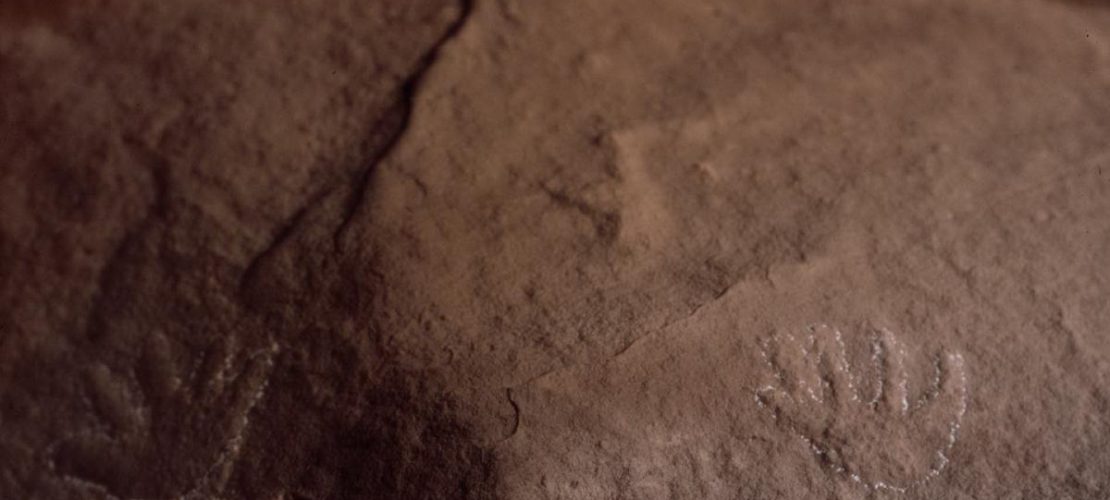
Typically, the qalta is near the inscribed or painted wall (Figure 1 from Wadi Umha). Also, in some sites, we find drawings or engravings of children’s hands as signatures on the walls, as in (Figures 2 and 3) from Jebel Toummo. Some specialists believe that children participated in painting on the walls, but the truth is that these hands were the shaman’s signature, but in their capacity as one of the Children of the Water.
1- The Signs of All Times- Entoptic Phenomena in Upper Palaeolithic Art- J. D. Lewis-Williams and T. A. Dowson-CURRENT ANTHROPOLOGY Volume 29, Number 2, April 1988- p 205.
2- Shamans, Portals, and Water Babies: Southern Paiute Mirrored Landscapes in Southern Nevada-Kathleen Van Vlack, Richard Arnold , and Alannah Bell – https://doi.org/10.3390/arts14030056. p1
3- Of water and the spirit: ritual, magic, and initiation in the life of an African Shaman- Malidoma Patrice Some-Published by G. P. Putnam’s Sons- 1994- p 240.
4- RAIN AND ROCK ART IN THE SAHARA: A POSSIBLE INTERPRETATION-Jitka Soukopova- Published 2020- p 80.
5- ANTHROPOLOGICAL RECORDS 2:1 TUIBATULABAL ETHNOGRAPHY, BY ERMINIE W. VOEGELIN- UNIVERSVY OF CALIFORNIA PRESSBERKELEY, CALIFORNIA 1938 p 64.
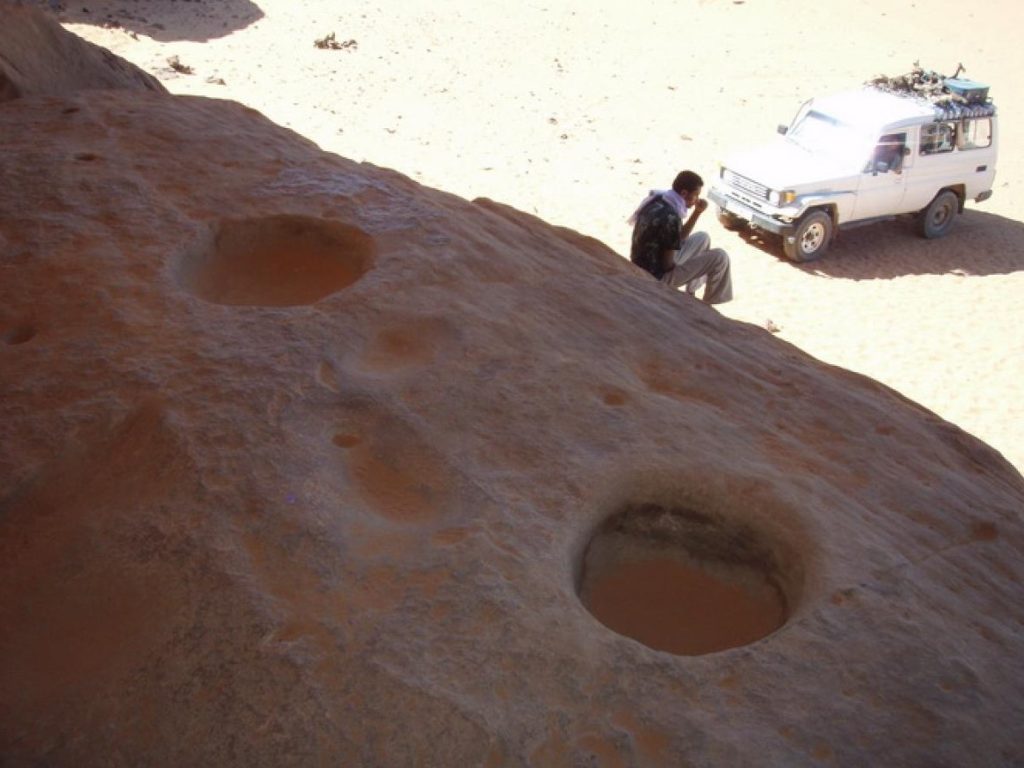
1- Wadi Imha ©roundheadsahara
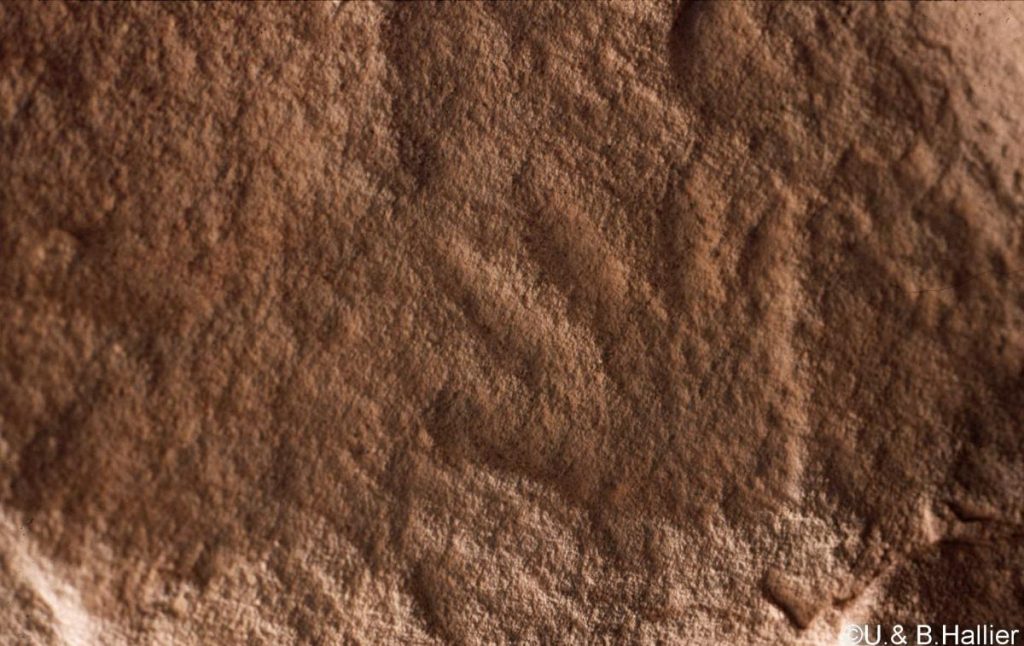
2- Jebel Toummo ©U.&B Hallier
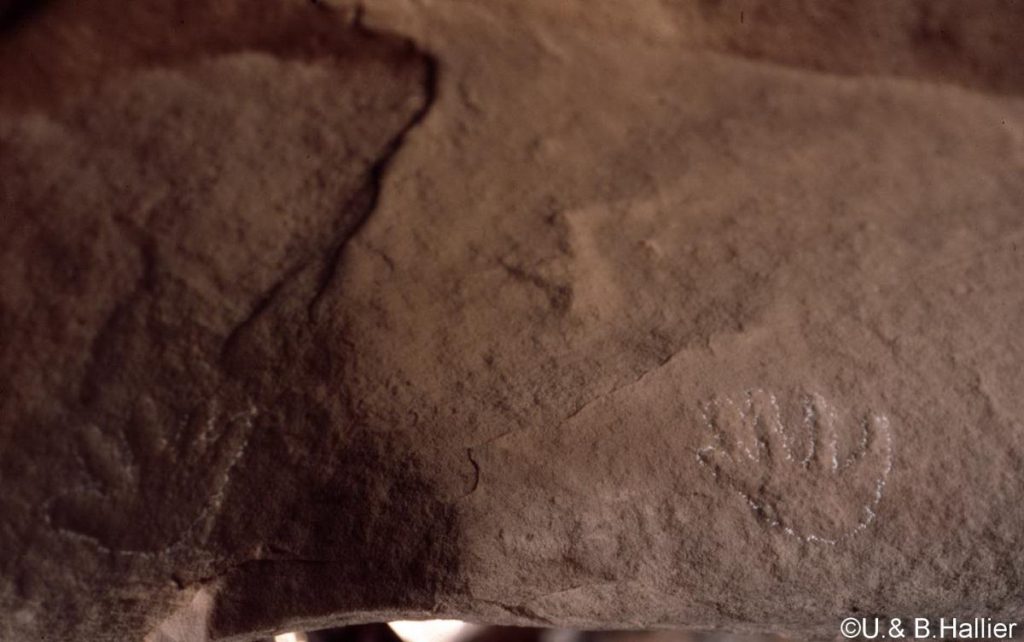
3- Jebel Toummo©U.&B Hallier

Mohammed Abdallah AlThrhuni
writer and researcher
Share now: