Our Innocent Anthropology
Article: Anthropology | Hamza Alfallah, 2026
When I was a university student, anthropology did not promise me much, or at least I did not consider it as a major alongside my sociology degree, due to its absence from Libyan universities. There was only a general introduction and some summaries that I would not move from their place except to attend a mid-week lecture. Even after obtaining my Bachelor’s degree in sociology, I did not pursue discovering it, or even writing about history. During that period, I was preoccupied with the idea of advancing in my academic career to postgraduate studies and settling into the professional dream of a high-achieving graduate to remain as a teaching assistant in the department.
All of this was before encountering the spontaneity of Gilles Deleuze, the orbital paths of Claude Lévi-Strauss, the arteries of Eduardo Galeano, the poetics of Nicolas Bouvier, the rebellion of Margaret Mead, and finally, before meeting the writer Mohamed Abdullah Altrhouni and the visual artist Shefa Salem.
This meeting, which I always described as the meeting of Maurice Blanchot’s “obscure community,” was like a forest of waking dreams, an anxious pursuit obsessed with perfection, and a sense of the necessity to find the counter-painting and the counter-text to confront the rigidity of the academic institution. That institution suffers from a constant void of feeling, a permanent emotional need to write about something, and the centrality of accumulating arid humanities research in our university. And where else could three people, enamored with a beauty named Libya, and any land worthy of journeying to carry the fertility of its ancient legacy, turn except to Art?
This is the land through which anthropology infiltrated from the anxiety of knowledge and the perpetual insufficiency of what we want to say—a soft infiltration like a gentle wave on Sabri beach, absorbed by the damp sands of nostalgia. Through all those short passages of Nicolas Bouvier, which would flicker in the sky when Altrhouni recited them like a forgotten poet in a café. Altrhouni was a lone star burning to avoid falling into a coma induced by these words, without papers or small notebooks for taking notes that would burden our sessions—just coffee, cigarettes, and Bouvier’s visions of the world dissolving into the scents of vegetables and oils, the perfume of flowers, and liquid pathways of imagination.
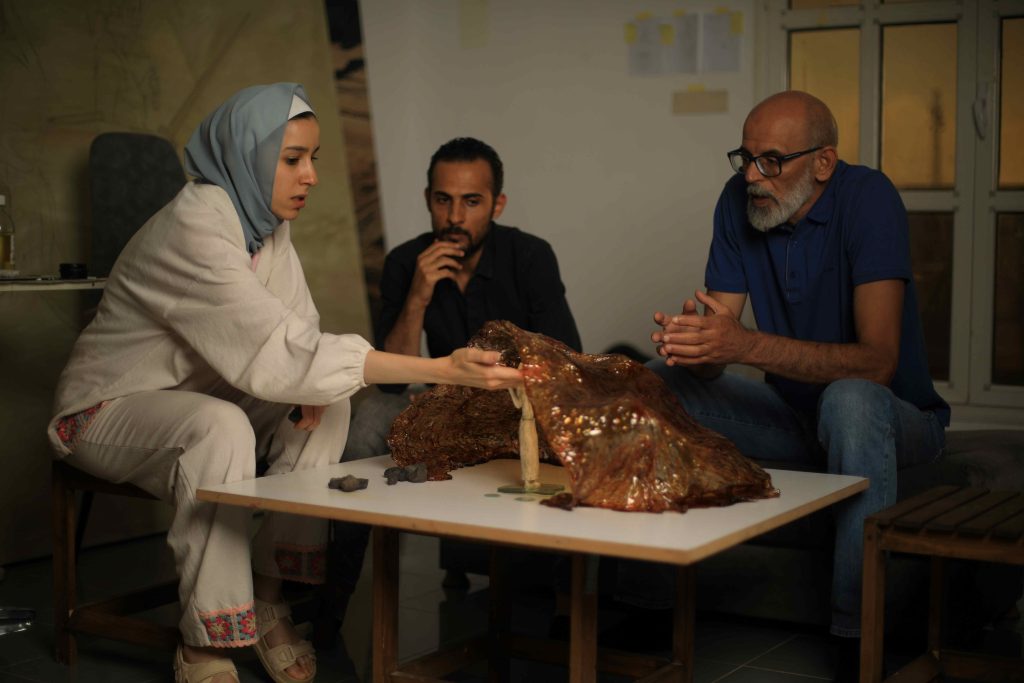
Because sitting was never enough for us, that period was filled with the long insomnias of Shefa, striving to launch her first solo exhibition, “I Am Libya.” Shefa, the artist who transformed her narrative epic about history inside her studio—cluttered with color tubes, canvas pieces, and broken brushes—into much work to confront the copyists of commercial studios devoid of ideas. There, near a bare balcony without curtains, invaded by the sun to warm the studio’s chill in winter, she invented an anthropology of colors that belongs to us in her paintings—an anthropology teeming with the white feathers of unknown leaders, fresh goat skins, jewelry shining from intense grief, armbands on Amazons, and ripe tattoos on the shoulders of ancestors.
Because we were, for many consecutive months, never without work, the text had to mirror the artist’s anxiety about a secret promise with the scent of clay for Libya, as we imagined it in the café—a promise she had made to herself to necessarily show this anthropological poetics to the world with her brushes. And as agreed, this exhibition was the first spark to move forward. However, all these dreams were not without stumbling and the pain of continuing to live.
Shefa, the architect, had joined teaching and quietly shed her shell after graduating from university. Altrhouni never stopped traversing the streets of Benghazi searching for a truck to rent to move his household belongings with each new displacement from one apartment to another, carrying on his shoulders the stone of Sisyphus to push this project up a mountain of pressures accumulated over grey years devoid of any artistic climate within the city—a climate we strived to create, away from the chaos of social obligations, scarce financial resources, and long immersion in the whirlpool of government jobs. Precisely, that period was one of movement and turbulence to sustain the project and work in an atmosphere of writing and painting.
A small part of Altrhouni’s salary would reach us, and a little from my father, who believed in the love that I was doing what I must to feel I was still alive, at least, amidst the rubble of a city that had emerged a few years earlier from the absurdity of war.
Away from neutral descriptions, to approach narratives that express our past, our poetic passion for a Libyan anthropology remained our only path—a passion saturated with anxiety and fascination with another world. That marginal world where the romance of writing about prehistoric Libya is situated, a writing driven by nostalgia to enter the domains of different specializations. This project was a conscious work propelled by the need to write against all forms of racial centrality in Western research, voices that do not represent us, and the racism that produces amnesia, as Eduardo Galeano tells us.
Altrhouni expressed this anthropology directly in the poetics of the Libyan Odyssey—the poetics of Libyan religion, desert rituals, rain-making, and the cultural impact of the climate crisis on the perceptions of ancient Libyans, who were pushed from the Tadrart Acacus to migrate in search of the prophecy of water. This aligns with the importance of anthropology today to correct the course, and with the humanity of sharing survival in a time when it was impossible. As researcher Frances Payne tells us about that importance: “It lies in clarifying misunderstandings and confusion among people everywhere, and correcting misinterpretations widespread across the world.”1 Perhaps this vision is the essence of an anthropology that promises us not only knowledge of the Other but an understanding of the nature of their cultural experience and relationship with the environment, to translate it into ideas we lack, not them, and into inspired artistic works we feel are needed to restore balance with what is missing today in our age. As the American anthropologist Paul Stoller points to that balance and defines it as the secret wisdom granted by studying the anthropology of local cultures, saying:
“During my fieldwork, one morning, my teacher Adamu Jenitongo woke me and said, ‘I have something important to tell you.’ I got up and we went. He said, ‘Go to the side of my spirit hut; we will sit on the straw mat.’ Then we sat and drank some tea. He looked into the bush and said, ‘You know, things are not good today.’ I said, ‘Why?’ He said, ‘There is no respect for the bush, for the thickets, and people in town do not respect each other, and when there is this recklessness, things go wrong. If you don’t respect the bush, you will face drought, insects, and you won’t harvest crops. If there is no mutual respect, a disturbance occurs that creates different kinds of conflicts.’ Then he added, ‘This is my job, and you must listen to this well. My job is to make offerings to restore balance due to the disturbance caused by our lack of respect for nature.'”2
I can fully feel this wisdom that researcher Paul Stoller tells us in his story with his spiritual guide, upon meeting our first “earth-attached” person in the valleys of Suknah. Our journey to the Black Mountains, traversing all those reefs we climbed together, restored within us this kind of balance with the earth and the landscape, amidst an environment of basalt stones where, at first glance, you could feel no empathy or love except the pain from the harshness of their silent explosion along the horizon.
However, during fieldwork among the different sites, we felt the nostalgia of all those “earth-attached” individuals (Imhamed, Abdul Latif, Mahmoud, and Yusuf) as they covered vast distances at dusk searching for rock inscriptions to help us conduct comparisons and deepen our research. This nostalgia was never driven by a desire to assist writers wanting to write, nor merely an exploratory trip for a scientific discovery, but an anthropological wisdom specific to our history, aware of the costly price of poetics in standing on the brink of knowledge to rescue empathy without dissolving into a world that consumes everything—a wisdom that lies in the slow listening to the meaning of loving a valley, a stone, a bird, or a lone tree resisting death, exactly like the earth-attached person and their loving gaze towards every small shelter, grave, refuge, and healing plant that helps them endure spiritual thirst to resist reductionism, defending plurality without distinction between what is creative or scientific. Because they see in their identity nothing but human behavior to unify the earth without borders, and this is what we want our innocent anthropology to be built upon.
1 Kirsten Hastrup, Michael Herzfeld, Paul Stoller, and Frances Pine, Why do anthropology today? (podcast, recorded in Warsaw, June 2025)
2 Paul Stoller, Why do anthropology today?
Share now: